Immersive censorship.

The future of virtual reality isn’t just about whether or not it causes a stampede at your local big-box retailer, ends up in bedrooms and living rooms around the world, or enables new artistic achievements­—if, in short, VR becomes a mass medium. Let’s get past that and ask: then what? Take a January 2014 article on Forbes’ website titled “Legal Heroin: Is Virtual Reality Our Next Hard Drug”. I assume the authors left out the question mark because they’d already made up their minds. The article lurches from irresponsible comparisons of the effects of VR immersion with middle America’s worst nightmares (“a rapid hit of speed, heroin, ecstasy, marijuana, and cocaine”) to singing the potential praises of VR as a learning tool.

If you’re up on media history, that kind of overblown language sounds mighty familiar. Looking back at media panics—from dime novels to train robbery flicks to horror comics to videogames—it’s easy to imagine how VR might be vulnerable to a similar wave of fear. Those previous panics look ridiculous in hindsight: In 1954, Fredric Wertham declared Batman and Robin secret lovers in front of a U.S. Senate subcommittee as part of his crusade against comic books. In the halcyon early '50s, when comic books overflowed on newsstands, Wertham's bullying played a key part in relegating sales to their current specialty market. Even pinball machines were banned in most major U.S. cities for four decades because of their alleged deleterious effects on the nation’s youth.

Looking back at media panics, it’s easy to imagine how VR might be vulnerable to a similar wave of fear 

There’s a definite cycle of mistrust, misunderstanding, and censorship by older generationsofthe new media embraced by youth. Dr. Dmitri Williams, a professor at the University of Southern California, calls this cycle the River City effect, referencing a tune from The Music Man. Williams describes three phases of reactions to new media used by kids: worries about the activities the media displaces, fears about health problems caused by the new tech, and opportunities to assign them blame for larger social problems. VR has some peculiarities that make it a fine target for all three phases.

What will be displaced? The physical world, for a start. Immersion in a virtual world is exclusion from the world around you. When a teenager is playing a console on the TV in her room, she can still turn her head to listen and look at her mom when she asks how her day has been or whether or not her homework is finished. That same mom might have a harder time accepting her offspring whiling away her free time behind goggles and headphones that completely block out the outside world. The inhuman, slightly sinister design of the headsets mocked up in prototypes and concept art isn’t doing the medium any favors: Headsets that obscure most of the user’s face transform a familiar daughter into a cyborg interloper occupying the living room couch. For bonus points, put a plastic gun in the player’s hands, or have them swing their fists to punch.

If game creators do their jobs right, the player’s mouth will be zombielike in slack-jawed ecstasy or twisted into a lunatic’s rageful maw, caught in the ecstasy of popping a cap into a noob or disemboweling an unfortunate goblin. Watching someone’s entire body react to a world you can’t see is deeply unsettling. Something about blocking out the outside world makes you forget to wear the mask of normalcy. Because VR seeks to mimic the senses by covering up the outside world with the virtual, it doesn’t allow passerby to become spectators with the same ease. The fertile imaginations of a fearful parent can populate what goes on beneath those goggles with their worst nightmares of debaucherous sex and violence.

Let’s say Mom wants to try out VR for herself and straps the goggles on. Ten minutes later, she’s staggering down the hallway to eject dinner into the toilet bowl Professor Williams’ health issues phase of the River City effect. “Simulator sickness” has been the bane of virtual world development for decades­—it’s something like motion sickness, but for virtual worlds, and while motion sickness usually requires long-term or extreme exposure, like a cruise or a roller-coaster ride, just being in VR makes some people sick. Maybe commercial hardware developers will be able to crack the simulator sickness problem where the military-industrial complex and its mountains of cash failed. But given that simulator sickness is caused by a variety of factors—including the design of the virtual environment and player movement—that manifest in varying ways, degrees, and populations, a certain percentage of people will likely never be able to experience VR without nausea.

Headsets that obscure most of the user’s face transform a familiar daughter into a cyborg interloper occupying the living room couch 

Still, most people develop a higher tolerance to simulator sickness over time through gradual exposure. So an excited teenager might get past some initial wooziness over the course of a few weeks, but a parent who wants to see what all the fuss is about could plunge into a virtual environment and end up severely disoriented. This problem isn’t going to be restricted to parents: If kids today remain anything like kids have always been, they’re probably going to overdo it on their new toys with marathon VR sessions. Christmas might get messy.

Making someone hurl isn’t generally considered a great first impression, and the cipher of VR is going to absorb all the perennial fears and complaints about young people. These complaints become a crisis of conscience when sharpened by links to the kind of horrific violence that has become all too routine in America, in tragedies like Columbine, Virginia Tech, and Sandy Hook. This is the final phase of Williams’ River City effect, where the most troubling issues facing a society are blamed on a younger generation’s embrace of new media. After the angry newspaper editorials, the outraged appearances on talk shows, and overplayed clips of the most extreme content VR has to offer run for days, what would the case for regulating and censoring the new medium look like?

Each new medium has to be explicitly approved by the justices as speech before it’s protected 

Some precedents have been set. In 2011, the United States Supreme Court declared videogames protected speech. Unfortunately, they’ve never gotten around to giving a definition of speech that has much predictive power: Each new medium has to be explicitly approved by the justices as speech before it’s protected. The first step for would-be goggle-grabbers will be to make the case that VR is a radically new medium and assert that its greater interactivity and realism are fundamentally different and more dangerous than what came before it. If they can manage that, the four decades of case law and precedent that established videogames as part of the First Amendment will be irrelevant.

The next step is to make the argument that VR isn’t speech at all; this is exactly what happened to videogames in 1982. By collapsing motion-based technology into the same category, legislators might make the argument that VR isn’t speech but action, which has a much lower barrier to regulation. When something is considered speech by the courts, any legislation regulating or censoring it must pass a very high standard of proof known as “strict scrutiny”, and the videogame speech case suggested that media effects research isn’t going to get there anytime soon. If it’s not speech, restrictive laws have to pass only the “rational basis” test: Basically, if the lawmakers give any justification at all, that’s good enough for the courts. That result could be disastrous, giving enterprising local, state, and federal politicians free reign to censor virtual reality for children or even adults. A promising new medium could be snuffed out under the onerous weight of regulation.

VR is still protean in its technical and cultural configuration: The future will bring many surprises and new wrinkles to an age-old contest between young and old. The best insurance against a future of censorship for VR is by making sure a generation gap doesn’t develop. The best way to do that is by showing people who wouldn’t otherwise put on a pair of goggles what VR is like, and by showing politicians that voters recognize the cycle of censorship and fear-mongering surrounding the birth of new media.
Most quoted quote.

TV advertising used to work like this: you sat on your sofa while creatives were paid to throw a bucket of shit in your face. Today you're expected to sit on the bucket, fill it with your own shit, and tip it over your head while filming yourself on your mobile. Then you upload the video to the creatives. You do the work; they still get paid.

Hail the rise of "loser-generated content"; commercials assembled from footage shot by members of the public coaxed into participating with the promise of TV glory. The advantages to the advertiser are obvious: it saves cash and makes your advert feel like part of some warm, communal celebration rather than the 30-second helping of underlit YouTube dog piss it is.

Charlie Brooker (2009) Charlie Brooker's Screen burn

Reality is disappearing.

The disappearance of God has left us facing reality and the ideal prospect of transforming this real world. And we have found ourselves confronted with the undertaking of realizing the world, of making it become technically, integrally real.

···

Now, the world, even freed from all illusion, does not lend itself at all to reality. The more we advance in this undertaking, the more ambiguous it becomes, the more it loses sight of itself. Reality has barely had time to exist and already it is disappearing…

It is the excess of reality that makes us stop believing in it. The saturation of the world, the technical saturation of life, the excess of possibilities, of actualization of needs and desires. How are we to believe in reality once its production has become automatic?

The real is suffocated by its own accumulation. There is no way now for the dream to be an expression of a desire since its virtual accomplishment is already present.

Deprivation of dreams, deprivation of desire. And we know what mental disorder sleep deprivation induces.

Deep down, the problem is the same as with the ‘accursed share’: the problem of the surplus – not the lack, but the excess of reality – of which we no longer know how to rid ourselves.

There is no longer any symbolic resolution, by sacrifice, of the surplus, except in accidents or by the irruption of an anomic violence which, whatever its social or political determinations, is always a challenge to this irresistible objective constraint of a normalized world.

···

The eclipse of God left us up against reality. Where will the eclipse of reality leave us?

In the name of the brain.

Apology letter from the brain

Hey there,

I’m sorry, okay? But can I say something?

Look, I admit I wasn’t perfect. No one is perfect. That’s a fact. Speaking of facts, don’t you think we all need to take a minute and decide who is right and who is wrong? Every side is different; it’s just that my side seems more right. I am not just saying that because it’s my side. I think a lot of other people would agree with me if given the chance.

If I upset you in some way, please know that wasn’t my intention. I didn’t know how sensitive you were. It’s obvious I can set you off very easily. That’s not an insult, it’s just an observation.

I think it would help if we talked about this more and argued about who is telling the truth. I would like to see you in person to tell you how this situation has affected me. I may use this opportunity to bring up other times you have hurt me in the past. If possible, I would like to hurt you back. Either way, I want to be in control.

Until then, take care and please remember I reached out first.

I Remain,
THE BRAIN.

Poehler, Amy (2014) Yes Please.

Read between the lines.

The Rosetta Stone survived unread through 2,000 years of further foreign occupations. After the Greeks came Romans, Byzantines, Persians, Muslim Arabs and Otoman Turks – all had stretches of rule in Egypt. At some point the stone was moved from the temple at Sais in the Nile Delta, where it was first erected, to the town of el-Rashid, now known as Rosetta, about forty miles away.

Then, in 1798, Napoleon arrived. The French invasion was of course primarily military (they wanted to cut the British route to India). But with the French army came scholars. Soldiers rebuilding fortifications in Rosetta dug up the stone – and accompanying experts knew immediately that they had found something of great significance.

The French seized the stone as a trophy of war, but it never made it back to Paris. With his fleet destroyed by Nelson at the Battle of the Nile, Napoleon himself returned to France, leaving the French army behind. In 1801 the French surrendered to the British and Egyptian generals. The terms of the Treaty of Alexandria included the handing over of antiquities, among them the Rosetta Stone.

Most books will tell you, as I just have, that there are three languages on the Rosetta Stone, but if you look on the broken side you can see a fourth. There, painted in English, you can read: CAPTURED IN EGYPT BY THE BRITISH ARMY IN 1801 (and elsewhere) PRESENTED BY KING GEORGE III. Nothing could make it clearer that while the text on the front of the stone is about the first European empire in Africa, Alexander the Great's, the finding of the stone stands at the beginning of another European adventure: the bitter rivalry between Britain and France for dominance in the Middle East and Africa, which continued from the time of Napoleon until the Second World War. I asked the Egyptian writer Ahdaf Soueif for his view of this history:

"This stone makes me think of how often Egypt has been the theatre of other people's battles. It's one of the earliest objects through which you can trace Western colonial interest in Egypt. The French and the British argued over it; nobody seems to have considered that it belonged to neither of them. Egypt's foreign rulers, from the Romans to the Turks to the British, have always made free with Egypt's heritage. Egypt had foreign rulers for 2,000 years, and in 1952 much was made of the fact that Nasser was the first Egyptian ruler since the pharaohs."

MacGregor, Neil (2010) A History of the World in 100 Objects.

Secret handshake.

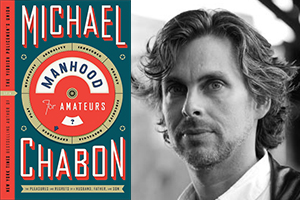
Every work of art is one half of a secret handshake, a challenge that seeks the password, a heliograph flashed from a tower window, an act of hopeless optimism in the service of bottomless longing. Every great record or novel or comic book convenes the first meeting of a fan club whose membership stands forever at one but which maintains chapters in every city—in every cranium—in the world. Art, like fandom, asserts the possibility of fellowship in a world built entirily from the materials of solitude. The novelist, the cartoonist, the songwriter, knows that the gesture is doomed from the beginning but makes it anyway, flashes his or her bit of mirror, not on the chance that the signal will be seen or understood but as if such a chance existed.

Technologies have biases.

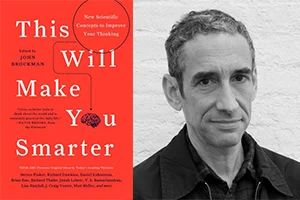
People like to think of technologies and media as neutral and that only their use or content determines their impact. Guns don’t kill people, after all, people kill people. But guns are much more biased toward killing people than, say, pillows — even though many a pillow has been utilized to smother an aging relative or adulterous spouse.

Our widespread inability to recognize or even acknowledge the biases of the technologies we use renders us incapable of gaining any real agency through them. We accept our iPads, Facebook accounts and automobiles at face value — as pre-existing conditions — rather than tools with embedded biases.

Marshall McLuhan exhorted us to recognize that our media have impacts on us beyond whatever content is being transmitted through them. And while his message was itself garbled by the media through which he expressed it (the medium is the what?) it is true enough to be generalized to all technology. We are free to use any car we like to get to work — gasoline, diesel, electric, or hydrogen — and this sense of choice blinds us to the fundamental bias of the automobile towards distance, commuting, suburbs, and energy consumption.

Likewise, soft technologies from central currency to psychotherapy are biased in their construction as much as their implementation. No matter how we spend US dollars, we are nonetheless fortifying banking and the centralization of capital. Put a psychotherapist on his own couch and a patient in the chair, and the therapist will begin to exhibit treatable pathologies. It’s set up that way, just as Facebook is set up to make us think of ourselves in terms of our “likes” and an iPad is set up to make us start paying for media and stop producing it ourselves.

If the concept that technologies have biases were to become common knowledge, we would put ourselves in a position to implement them consciously and purposefully. If we don’t bring this concept into general awareness, our technologies and their effects will continue to threaten and confound us.

A-players and A-bombs.

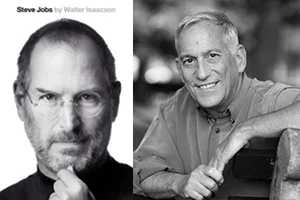
For most things in life, the range between best and average is 30% or so. The best airplane flight, the best meal, they may be 30% better than your average one. What I saw with Woz was somebody who was fifty times better than the average engineer. He could have meetings in his head. The Mac team was an attempt to build a whole team like that, A players. People said they wouldn’t get along, they’d hate working with each other . But I realized that A players like to work with A players , they just didn’t like working with C players. At Pixar, it was a whole company of A players. When I got back to Apple, that’s what I decided to try to do. You need to have a collaborative hiring process. When we hire someone, even if they’re going to be in marketing, I will have them talk to the design folks and the engineers. My role model was J. Robert Oppenheimer. I read about the type of people he sought for the atom bomb project. I wasn’t nearly as good as he was, but that’s what I aspired to do.

Walter Isaacson (2011). Steve Jobs.

Live your life at 80%.

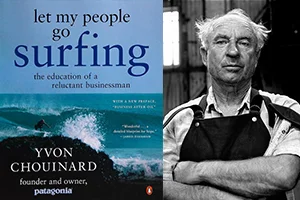
I’ve always thought of myself as an 80 percenter. I like to throw myself passionately into a sport or activity until I reach about an 80 percent proficiency level. To go beyond that requires an obsession and degree of specialization that doesn’t appeal to me. Once I reach that 80 percent level I like to go off and do something totally different; that probably explains the diversity of the Patagonia product line—and why our versatile, multifaceted clothes are the most successful.

The great leap backwards.

In 1957, a billion Chinese were going hungry.
Mao Zedong couldn’t admit this was because of the failings of his communist agricultural policies.
The reason must be something else.
He heard that sparrows were eating lots of grain.
That must be the reason.
So began ‘The Great Sparrow Campaign’.
The people must do whatever was necessary to rid China of sparrows.
That way the people would have plenty to eat.
It became everyone’s responsibility to help wipe out sparrows.
Masses of schoolchildren were taken on outings to destroy nests, to smash eggs, to kill chicks.
Everyone with any kind of gun was told to shoot sparrows wherever they saw them.
Poison was put wherever sparrows lived.
The Chinese organised in thousands to visit the areas where the sparrows gathered.
They did anything to stop them landing in the trees.
They made vast amounts of noise: sounding horns, thumping drums, even banging old pots and pans.
Propaganda films of the period show entire villages participating right across China.
They wouldn’t let the sparrows land and eventually the sparrows exhausted themselves and dropped to earth dead.
All over China, towns and villages were given recognition for the amount of sparrows they killed.
One day alone, in Shanghai, they killed 198,000.
Eventually, sparrows in China were eradicated, around two billion birds.
So that was the end of the problem, now food would be plentiful.
Well not quite.
What Mao Zedong hadn’t allowed for was what else the sparrows ate, besides grain.
They ate locusts.
Without the sparrows, the locusts had nothing to stop them.
They multiplied on a massive scale.
And locusts were many times more destructive than sparrows.
Plagues of locusts took over huge areas of Chinese farmland.
Each swarm covering hundreds of square miles made up of trillions of locusts.
It resulted in the Great Famine.
Which resulted in thirty million people dead from starvation.
Which created a new problem: what could be done to control the locusts?
The only solution was for China to import millions of sparrows from Communist Russia.
To try to put everything back the way it had been.
Because the solution had been worse than the problem.
Which is pretty much what’s happened to advertising.
Advertising was good, but we were looking for a way to make it better.
So we had to replace intuition and normal common-sense.
We had to make everything rational and verifiable, measurable and accountable, sensible and scientific.
And what happened?
We killed off the intuitive, the common-sense, the fun.
Advertising became formulaic, dull, invisible and predictable.

We killed off the sparrows and the locusts were worse.

Dave Trott (2015) Dave Trott's Blog.

Competition is for incompetents—an ode to monopolies.

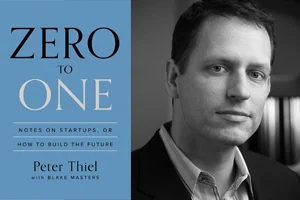
What valuable company is nobody building? This question is harder than it looks, because your company could create a lot of value without becoming very valuable itself. Creating value isn't enough—you also need to capture some of the value you create.

This means that even very big businesses can be bad businesses. For example, U.S. airline companies serve millions of passengers and create hundreds of billions of dollars of value each year. But in 2012, when the average airfare each way was $178, the airlines made only 37 cents per passenger trip. Compare them to Google, which creates less value but captures far more. Google brought in $50 billion in 2012 (versus $160 billion for the airlines), but it kept 21% of those revenues as profits—more than 100 times the airline industry's profit margin that year. Google makes so much money that it is now worth three times more than every U.S. airline combined.

The airlines compete with each other, but Google stands alone. Economists use two simplified models to explain the difference: perfect competition and monopoly.

"Perfect competition" is considered both the ideal and the default state in Economics 101. So-called perfectly competitive markets achieve equilibrium when producer supply meets consumer demand. Every firm in a competitive market is undifferentiated and sells the same homogeneous products. Since no firm has any market power, they must all sell at whatever price the market determines. If there is money to be made, new firms will enter the market, increase supply, drive prices down and thereby eliminate the profits that attracted them in the first place. If too many firms enter the market, they'll suffer losses, some will fold, and prices will rise back to sustainable levels. Under perfect competition, in the long run no company makes an economic profit.

The opposite of perfect competition is monopoly. Whereas a competitive firm must sell at the market price, a monopoly owns its market, so it can set its own prices. Since it has no competition, it produces at the quantity and price combination that maximizes its profits.

To an economist, every monopoly looks the same, whether it deviously eliminates rivals, secures a license from the state or innovates its way to the top. I'm not interested in illegal bullies or government favorites: By "monopoly," I mean the kind of company that is so good at what it does that no other firm can offer a close substitute. Google is a good example of a company that went from 0 to 1: It hasn't competed in search since the early 2000s, when it definitively distanced itself from Microsoft and Yahoo!

Americans mythologize competition and credit it with saving us from socialist bread lines. Actually, capitalism and competition are opposites. Capitalism is premised on the accumulation of capital, but under perfect competition, all profits get competed away. The lesson for entrepreneurs is clear: If you want to create and capture lasting value, don't build an undifferentiated commodity business.

How much of the world is actually monopolistic? How much is truly competitive? It is hard to say because our common conversation about these matters is so confused. To the outside observer, all businesses can seem reasonably alike, so it is easy to perceive only small differences between them. But the reality is much more binary than that. There is an enormous difference between perfect competition and monopoly, and most businesses are much closer to one extreme than we commonly realize.

The confusion comes from a universal bias for describing market conditions in self-serving ways: Both monopolists and competitors are incentivized to bend the truth.

Monopolists lie to protect themselves. They know that bragging about their great monopoly invites being audited, scrutinized and attacked. Since they very much want their monopoly profits to continue unmolested, they tend to do whatever they can to conceal their monopoly—usually by exaggerating the power of their (nonexistent) competition.

Think about how Google talks about its business. It certainly doesn't claim to be a monopoly. But is it one? Well, it depends: a monopoly in what? Let's say that Google is primarily a search engine. As of May 2014, it owns about 68% of the search market. (Its closest competitors, Microsoft and Yahoo!, have about 19% and 10%, respectively.) If that doesn't seem dominant enough, consider the fact that the word "google" is now an official entry in the Oxford English Dictionary—as a verb. Don't hold your breath waiting for that to happen to Bing.

But suppose we say that Google is primarily an advertising company. That changes things. The U.S. search-engine advertising market is $17 billion annually. Online advertising is $37 billion annually. The entire U.S. advertising market is $150 billion. And global advertising is a $495 billion market. So even if Google completely monopolized U.S. search-engine advertising, it would own just 3.4% of the global advertising market. From this angle, Google looks like a small player in a competitive world.

What if we frame Google as a multifaceted technology company instead? This seems reasonable enough; in addition to its search engine, Google makes dozens of other software products, not to mention robotic cars, Android phones and wearable computers. But 95% of Google's revenue comes from search advertising; its other products generated just $2.35 billion in 2012 and its consumer-tech products a mere fraction of that. Since consumer tech is a $964 billion market globally, Google owns less than 0.24% of it—a far cry from relevance, let alone monopoly. Framing itself as just another tech company allows Google to escape all sorts of unwanted attention.

Non-monopolists tell the opposite lie: "We're in a league of our own." Entrepreneurs are always biased to understate the scale of competition, but that is the biggest mistake a startup can make. The fatal temptation is to describe your market extremely narrowly so that you dominate it by definition.

Suppose you want to start a restaurant in Palo Alto that serves British food. "No one else is doing it," you might reason. "We'll own the entire market." But that is only true if the relevant market is the market for British food specifically. What if the actual market is the Palo Alto restaurant market in general? And what if all the restaurants in nearby towns are part of the relevant market as well?

These are hard questions, but the bigger problem is that you have an incentive not to ask them at all. When you hear that most new restaurants fail within one or two years, your instinct will be to come up with a story about how yours is different. You'll spend time trying to convince people that you are exceptional instead of seriously considering whether that is true. It would be better to pause and consider whether there are people in Palo Alto who would rather eat British food above all else. They may well not exist.

In 2001, my co-workers at PayPal and I would often get lunch on Castro Street in Mountain View, Calif. We had our pick of restaurants, starting with obvious categories like Indian, sushi and burgers. There were more options once we settled on a type: North Indian or South Indian, cheaper or fancier, and so on. In contrast to the competitive local restaurant market, PayPal was then the only email-based payments company in the world. We employed fewer people than the restaurants on Castro Street did, but our business was much more valuable than all those restaurants combined. Starting a new South Indian restaurant is a really hard way to make money. If you lose sight of competitive reality and focus on trivial differentiating factors—maybe you think your naan is superior because of your great-grandmother's recipe—your business is unlikely to survive.

The problem with a competitive business goes beyond lack of profits. Imagine you're running one of those restaurants in Mountain View. You're not that different from dozens of your competitors, so you've got to fight hard to survive. If you offer affordable food with low margins, you can probably pay employees only minimum wage. And you'll need to squeeze out every efficiency: That is why small restaurants put Grandma to work at the register and make the kids wash dishes in the back.

A monopoly like Google is different. Since it doesn't have to worry about competing with anyone, it has wider latitude to care about its workers, its products and its impact on the wider world. Google's motto—"Don't be evil"—is in part a branding ploy, but it is also characteristic of a kind of business that is successful enough to take ethics seriously without jeopardizing its own existence. In business, money is either an important thing or it is everything. Monopolists can afford to think about things other than making money; non-monopolists can't. In perfect competition, a business is so focused on today's margins that it can't possibly plan for a long-term future. Only one thing can allow a business to transcend the daily brute struggle for survival: monopoly profits.

So a monopoly is good for everyone on the inside, but what about everyone on the outside? Do outsize profits come at the expense of the rest of society? Actually, yes: Profits come out of customers' wallets, and monopolies deserve their bad reputation—but only in a world where nothing changes.

In a static world, a monopolist is just a rent collector. If you corner the market for something, you can jack up the price; others will have no choice but to buy from you. Think of the famous board game: Deeds are shuffled around from player to player, but the board never changes. There is no way to win by inventing a better kind of real-estate development. The relative values of the properties are fixed for all time, so all you can do is try to buy them up.

But the world we live in is dynamic: We can invent new and better things. Creative monopolists give customers more choices by adding entirely new categories of abundance to the world. Creative monopolies aren't just good for the rest of society; they're powerful engines for making it better.

Even the government knows this: That is why one of its departments works hard to create monopolies (by granting patents to new inventions) even though another part hunts them down (by prosecuting antitrust cases). It is possible to question whether anyone should really be awarded a monopoly simply for having been the first to think of something like a mobile software design. But something like Apple's monopoly profits from designing, producing and marketing the iPhone were clearly the reward for creating greater abundance, not artificial scarcity: Customers were happy to finally have the choice of paying high prices to get a smartphone that actually works. The dynamism of new monopolies itself explains why old monopolies don't strangle innovation. With Apple's iOS at the forefront, the rise of mobile computing has dramatically reduced Microsoft's decadeslong operating system dominance.

Before that, IBM's hardware monopoly of the 1960s and '70s was overtaken by Microsoft's software monopoly. AT&T had a monopoly on telephone service for most of the 20th century, but now anyone can get a cheap cellphone plan from any number of providers. If the tendency of monopoly businesses was to hold back progress, they would be dangerous, and we'd be right to oppose them. But the history of progress is a history of better monopoly businesses replacing incumbents. Monopolies drive progress because the promise of years or even decades of monopoly profits provides a powerful incentive to innovate. Then monopolies can keep innovating because profits enable them to make the long-term plans and finance the ambitious research projects that firms locked in competition can't dream of.

So why are economists obsessed with competition as an ideal state? It is a relic of history. Economists copied their mathematics from the work of 19th-century physicists: They see individuals and businesses as interchangeable atoms, not as unique creators. Their theories describe an equilibrium state of perfect competition because that is what's easy to model, not because it represents the best of business. But the long-run equilibrium predicted by 19th-century physics was a state in which all energy is evenly distributed and everything comes to rest—also known as the heat death of the universe. Whatever your views on thermodynamics, it is a powerful metaphor. In business, equilibrium means stasis, and stasis means death. If your industry is in a competitive equilibrium, the death of your business won't matter to the world; some other undifferentiated competitor will always be ready to take your place.

Perfect equilibrium may describe the void that is most of the universe. It may even characterize many businesses. But every new creation takes place far from equilibrium. In the real world outside economic theory, every business is successful exactly to the extent that it does something others cannot. Monopoly is therefore not a pathology or an exception. Monopoly is the condition of every successful business.

Tolstoy famously opens "Anna Karenina" by observing: "All happy families are alike; each unhappy family is unhappy in its own way." Business is the opposite. All happy companies are different: Each one earns a monopoly by solving a unique problem. All failed companies are the same: They failed to escape competition.

Straight up.

Blogger Jason Kottke wrestled with what to call this new class of entrepreneurship, these cottage industries with global reach targeting niche markets of distributed demand. “Boutique” is too pretentious, and “indie” not quite right. He observed that others had suggested “craftsman, artisan, bespoke, cloudless, studio, atelier, long tail, agile, bonsai company, mom and pop, small scale, specialty, anatomic, big heart, GTD business, dojo, haus, temple, coterie, and disco business.” But none seemed to capture the movement.

So he proposed “small batch,” a term most often applied to bourbon. In the spirits world, this implies handcrafted care. But it can broadly refer to businesses focused more on the quality of their products than the size of the market. They’d rather do something they were passionate about than go mass. And these days, when anyone can get access to manufacturing and distribution, that is actually a viable choice. Walmart, and all the compromise that comes with it, is no longer the only path to success.

The collective potential of a million garage tinkerers is about to be unleashed on the global markets, as ideas go straight into production, no financing or tooling required. “Three guys with laptops” used to describe a Web startup. Now it describes a hardware company, too. “Hardware is becoming much more like software,” as MIT professor Eric von Hippel puts it. 

The Web was just the proof-of-concept of what an open, bottom-up, collaborative industrial model could look like. Now the revolution hits the real world.

Constant variation.

Most successful big-company innovators I met, whether Chief Innovation Officers, innovation team members or people without an innovation job title but who are tackling a big change project for the first time, have something in common: they respect the organisation they work for, but they don't revere it. As innovators, they want their businesses to do better, but at the same time they are dissatisfied with the status quo. There's a kind of 'love-hate' going on. But too much love and an innovator becomes an ineffective 'yes-man'. Too much hate and he or she ends up an ineffective loner.

It's a delicate balancing act. I describe someone who effectively manages it as a 'Captain One Minute, Pirate the Next'. One minute the innovation leader is the Captain, the passionate man-with-the-plan, standing tall on the bridge of the ship and inspiring us all to go 'this way'. But the next time you meet, the Captain has morphed into a Pirate. This time he or she is down to the boiler room, sleeves rolled up, shipmates gathered around, using all of his or her cunning to shortcut a process, to subvert the system. Now our protagonist is asking really challenging questions: 'What if we did it differently? What if we ripped up the way things are done around here? What if?'

So one minute an innovation leader is stubbornly sticking to the big picture; the next he or she is telling you not to sweat the small stuff. I think this intriguing mix of vision and cunning comes from the fact that successful innovators are fixated by outcomes. They are highly motivated to make change happen - so much so that they're often less bothered about how they get there.

A hurdle called truth.

Magic requires tacit cooperation of the audience with the magician--an abandonment of skepticism, or what is sometimes described as the willing suspension of disbelief.

---

It was a 1954 book I had read in college, The Fifty-Minute Hour. The author, a psychoanalyst named Robert Lindner, had been called by the Los Alamos National Laboratory to treat a brilliant young nuclear physicist whose delusional system was beginning to interfere with his secret government research. The physicist (given the pseudonym Kirk Allen) had, it turned out, another life besides making nuclear weapons: in the far future, he confided, he piloted (or will pilot - the tenses get a little addled) interstellar spacecraft. He enjoyed rousing, swashbuckling adventures on planets of other stars. He was "lord" of many worlds. Perhaps they called him Captain Kirk. Not only could he "remember" this other life; he could also enter into it whenever he chose. By thinking in the right way, by wishing, he could transport himself across the light years and the centuries.

In some way I could not comprehend, by merely desiring it to be so, I had crossed the immensities of space, broken out of time, and merged with - literally became - that distant and future self . . . Don't ask me to explain. I can't, although God knows I've tried.

Lindner found him intelligent, sensitive, pleasant, polite and perfectly able to deal with everyday human affairs. But, in reflecting on the excitement of his life among the stars, Allen had found himself a little bored with his life on Earth, even if it did involve building weapons of mass destruction. When admonished by his laboratory supervisors for distraction and dreaminess, he apologized; he would try, he assured them, to spend more time on this planet. That's when they contacted Lindner. 

Allen had written 12,000 pages on his experiences in the future, and dozens of technical treatises on the geography, politics, architecture, astronomy, geology, life forms, genealogy and ecology of the planets of other stars. A flavour of the material is given by these monograph titles: "The Unique Brain Development of the Chrystopeds of Srom Norba X", "Fire Worship and Sacrifice on Srom Sodrat II", "The History of the Intergalactic Scientific Institute", and "The Application of Unified Field Theory and the Mechanics of the Stardrive to Space Travel". (That last is the one I'd like to see; after all, Allen was said to have been a first-rate physicist.) Fascinated, Lindner pored over the material. 

Allen was not in the least shy about presenting his writings to Lindner or discussing them in detail. Unflappable and intellectually formidable, he seemed not to be yielding an inch to Lindner's psychiatric ministrations. When everything else failed, the psychiatrist attempted something different:

I tried . . . to avoid giving in any way the impression that I was entering the lists with him to prove that he was psychotic, that this was to be a tug of war over the question of his sanity. Instead, because it was obvious that both his temperament and training were scientific, I set myself to capitalize on the one quality he had demonstrated throughout his life . . . the quality that urged him toward a scientific career: his curiosity .. . This meant . . . that at least for the time being I 'accepted' the validity of his experiences . . . In a sudden flash of inspiration it came to me that in order to separate Kirk from his madness it was necessary for me to enter his fantasy and, from that position, to pry him loose from the psychosis.

Lindner highlighted certain apparent contradictions in the documents and asked Allen to resolve them. This required the physicist to re-enter the future to find the answers. Dutifully, Allen would arrive at the next session with a clarifying document written in his neat hand. Lindner found himself eagerly awaiting each interview, so he could be once more captivated by the vision of abundant life and intelligence in the galaxy. Between them, they were able to resolve many problems of consistency. 

Then a strange thing happened: "The materials of Kirk's psychosis and the Achilles heel of my personality met and meshed like the gears of a clock." The psychoanalyst became a co-conspirator in his patient's delusion. He began to reject psychological explanations of Allen's story. How sure are we that it couldn't really be true? He found himself defending the notion that another life, that of a spacefarer in the far future, could be entered into by a simple effort of the will. 

At a startlingly rapid rate . . . larger and larger areas of my mind were being taken over by the fantasy . . . With Kirk's puzzled assistance I was taking part in cosmic adventures, sharing the exhilaration of the sweeping extravaganza he had plotted. 

But eventually, an even stranger thing happened: concerned for the well-being of his therapist, and mustering admirable reserves of integrity and courage, Kirk Allen confessed: he had made the whole thing up. It had roots in his lonely childhood and his unsuccessful relationships with women. He had shaded, and then forgotten, the boundary between reality and imagination. Filling in plausible details and weaving a rich tapestry about other worlds was challenging and exhilarating. He was sorry he had led Lindner down this primrose path. 

"Why," the psychiatrist asked, "why did you pretend? Why did you keep on telling me . . .?" 

"Because I felt I had to," the physicist replied. "Because I felt you wanted me to."

Kirk and I reversed roles, Lindner explained, and, in one of those startling denouements that make my work the unpredictable, wonderful and rewarding pursuit it is, the folly we shared collapsed . . . I employed the rationalization of clinical altruism for personal ends and thus fell into a trap that awaits all unwary therapists of the mind . . . Until Kirk Allen came into my life, I had never doubted my own stability. The aberrations of mind, so I had always thought, were for others . . . I am ashamed by this smugness. But now, as I listen from my chair behind the couch, I know better. I know that my chair and the couch are separated only by a thin line. I know that it is, after all, but a happier combination of accidents that determines, finally, who shall lie on the couch, and who shall sit behind it.

The relativity of time at work.

Interruption is the enemy of productivity

If you're constantly staying late and working weekends, it's not because there's too much work to be done. It's because you're not getting enough done at work. And the reason is interruptions.

Think about it: When do you get most of your work done? If you're like most people, it's at night or early in the morning. It's no coincidence that these are the times when nobody else is around.

At 2 p.m., people are usually in a meeting or answering e-mail or chatting with colleagues. Those taps on the shoulder and little impromptu get-togethers may seem harmless, but they're actually corrosive to productivity. Interruption is not collaboration, it’s just interruption. And when you're interrupted, you're not getting work done.

Interruptions break your workday into a series of work moments. Forty-five minutes and then you have a call. Fifteen minutes and then you have lunch. An hour later, you have an afternoon meeting. Before you know it, it's five o'clock, and you've only had a couple uninterrupted hours to get your work done. You can't get meaningful things done when you're constantly going start, stop, start, stop.

Instead, you should get in the alone zone. Long stretches of alone time are when you’re most productive. When you don't have to mind-shift between various tasks, you get a boatload done. (Ever notice how much work you get done on a plane since you’re offline and there are zero outside distractions?)

Getting into that zone takes time and requires avoiding interruptions. It's like REM sleep: You don't just go directly into REM sleep. You go to sleep first and then make your way to REM. Any interruptions force you to start over. And just as REM is when the real sleep magic happens, the alone zone is where the real productivity magic happens.

Your alone zone doesn't have to be in the wee hours, though. You can set up a rule at work that half the day is set aside for alone time. Decree that from 10 a.m. to 2p.m., people can't talk to each other (except during lunch). Or make the first or last half of the day your alone-time period. Or instead of casual Fridays, try no-talk Thursdays. Just make sure this period is unbroken in order to avoid productivity-zapping interruptions.

And go all the way with it. A successful alone-time period means letting go of communication addiction. During alone time, give up instant messages, phone calls, e-mail, and meetings. Just shut up and get to work. You'll be surprised how much more you get done.

Also, when you do collaborate, try to use passive communication tools, like e-mail, that don't require an instant reply, instead of interruptive ones, like phone calls and face-to-face meetings. That way people can respond when it's convenient for them, instead of being forced to drop everything right away.

Your day is under siege by interruptions. It's on you to fight back.