Framing Rubiales.

5. The final matter to consider bears upon the segregation issue expressed in "tension" and joking. As will be argued throughout, individuals can rather fully constitute what they see in accordance with the framework that officially applies. But there is a limit to this capacity. Certain effects carry over from one perspective in which events could easily be seen to a radically different one, the latter the one which officially applies. The best documented case, perhaps, is the slow development of the easy right of medical people to approach the human naked body with a natural instead of a social perspective. Thus, it was only at the end of the eighteenth century in Britain that childbirth could benefit from an obstetric examination, an undarkened operating room, and delivery—if a male physician was to do it—unencumbered by its having to be performed under covers.₁₆ The gynecological examination is even today a matter of some concern special effort being taken to infuse the procedure with terms and dottons that keep sexual readings in check.₁₇ Another example is the difficulty faced by those who would promote the practice of rescue breathing: mouth-to-mouth contact apparently cannot easily be dissociated from its ritual implications.₁₈ Similarly, we manage to let orthopedists and shoe salesmen touch our feet, but first we make sure to clean what might ritually contaminate. Or consider the Sensel, the instructor at karate, who, when his students take up a proper position, ordinarily can touch crucial points of their bodies instrumentally, as might a physician, to determine directly whether the appropriate tension is present Consider the question of limits to this sort of physicalistlc framing that is introduced by the admission of female students:

When Sensei makes the rounds to test our "stance," by touching the "butt and thigh muscles, he just doesn't touch ours. After three months he finally did touch the fifteen-year-old's "butt," but he sit avoids us older women like the plague. It seems clear that twenty. five-vear-old Sensei cannot see us as other than females who can be touched for one purpose and one purpose only. ₁₉

It should be obvious that the human body and touchings of it will figure in the issue of frame maintenance, just as the body's various waste products and involuntary movements will figure in tensions regarding boundaries.₂₀ For it seems that the body is too constantly present as a resource to be managed in accordance with only one primary framework. It seems inevitable that our interpretive competency will allow us to come to distinguish, say, between an arm waved to signal a car on and an arm waved to greet a friend, and that both wavings will be distinguished from what we are seen as doing when we dispel flies or increase circu-lation. These discernments in turn seem linked to the fact that each kind of event is but one element in a whole idiom of events, each idiom being part of a distinctive framework. And here what is true of Western society is probably also true of all other societies.₂₁

₁₆ Peter Fryer, Mrs. Grundy: Studies in English Prudery (London: Dennis Dobson, 1963), chap. 17, "The Creeping Obstetrician," pp. 167-170. It should not be assumed that in the West individuals have shown a continuously increasing capacity to suffer examination in a naturalistic perspective and treatment in a purely instrumental, "physicalistic" one. We no longer have slaves, and therefore, presumably, no longer do individuals have to suffer the kind of impersonal testing described by Harold Nicolson in Good Behaviour (London: Constable & Co., 1955) :

The slave dealers, whether those of Delos or the mangones who ran the slave-market by the Temple of Castor in Rome, would display their wares in the manner of horse-copers, allowing prospective purchasers to examine the teeth and muscles of the animals, taking them for little runs on a string to show their paces. Slaves were exhibited for sale in a wooden cage, their feet being smeared with white-wash, and tablets stating price and qualifications hung around their necks. [p. 63]

In any case, one should see that allowing ourselves to be treated as objects is a form of conduct, if only a passive one. Persons being made up by stage cosmeticians, measured by their tailors, and palpated by their physicians conduct themselves in much the same way. They respond to requests to assume various positions, may engage in desultory side talk, but the rest follows a widespread understanding as to how to act when we are supposed to be merely bodies.

₁₇ The staging of the gynecological examination so as to sustain non-sexual interpretations is nicely detailed in James M. Henslin and Mae A. Biggs, "Dramaturgical Desexualization: The Sociology of the Vaginal Examination," in James M. Henslin, ed., Studies in the Sociology of Sex (New York: Appleton-Century-Crofts, 1971), pp. 243-272. A useful treatment is also available in Joan P. Emerson, "Behavior in Private Places: Sustaining Definitions of Reality in Gynecological Examinations," in Hans Peter Dreitzel, ed., Recent Sociology No. 2 (New York: Macmillan, 1970), pp. 1-97. Emerson argues that although joking during a gynecological examination may provide too open a reference to what must be inhibited, other more subtle means will allow (and oblige) participants to give nonmedical matters (such as "feminine" modesty) their due. Here see also "A Simultaneous Multiplicity of Selves," in E., pp. 132-143. Emerson's paper provides a useful reminder that when one schema applies, its tenure may shift from moment to moment and may never totally exclude alien readings—and (it is felt) properly so.

₁₈ See, for example, Maurice E. Linden, "Some Psychological Aspects lescue Breathing," American Journal of Nursing, LX (1960): 971-974.

₁₉ Susan Pascalé et al., "Self-Defense for Women," in Robin Morgan, Sisterhood Is Powerful (New York: Random House, Vintage Books, 1970), p. 474.

₂₀ Mary Douglas, Purity and Danger (London: Routledge & Kegan Paul, 1966), provides a text:

But now we are ready to broach the central question. Why should bodily refuse be a symbol of danger and of power? Why should sorcerers be thought to qualify for initiation by shedding blood or committing incest or anthropophagy? Why, when initiated, should their art consist largely of manipulating powers thought to inhere in the margins of the human body? Why should bodily margins be thought to be specially invested with power and danger?

Second, all margins are dangerous. If they are pulled this way or that the shape of fundamental experience is altered. Any structure of ideas is vulnerable at its margins. We should expect the orifices of the body to symbolise its specially vulnerable points. Matters issuing from them is marginal stuff of the most obvious kind. Spittle, blood, milk, urine, faces or tears by simply issuing forth have traversed the boundary of the body. So also have bodily parings, skin, nail, hair clippings and sweat. The mistake is to treat bodily margins in isolation from all other margins. There is no reason to assume any primacy for the individual's attitude to his own bodily and emotional experience, any more than for his cultural and social experience. This is the clue which explains the unevenness with which different aspects of the body are treated in the rituals of the world. In some, menstrual pollution is feared as a lethal danger; in others not at all. ... In some, death pollution is a daily preoccupation; in others not at all. In some, excreta is dangerous, in others it is only a joke. In India cooked food and saliva are pollution-prone, but Bushmen collect melon seeds from their mouths for later roasting and eating. [pp. 120-121]

₂₁ A Borneo society might serve to provide an illustration:

The clasping of hands, or throwing an arm about the neck of a friend of the same sex, or a relative beyond the range of defined incestuous relationships, serves to establish boundaries of permitted tactile contacts in social action situations. Lovers regularly denote their status by mutually clasping waists while walking in public. Community members not related, or in the status of special friends, or lovers, are not permitted the familiarity of such forms, since each denotes a meaning of opening another close level of tactile experience. Touching or holding contacts are permitted among non-married adults of opposite sex only during instances of divination and curing relationships between a female ritual specialist and seriously ill persons. In the course of both divination and curing rituals a female specialist in the supernatural seeks out the site of illness through gross palpation of trunk and limb areas. In most in-stances, areas of sexual meaning are avoided. There is no practice of generational transfer of political power through tactile contact, although ritual and magical formula and associated power passage between an aged female ritual specialist and a girl pupil may involve clasping of hands as a symbolic transfer is effected. [Thomas R. Williams, "Cultural Structuring of Tactile Experience in a Borneo Society," American Anthro-pologist, LXVIII (1966): 33-34.]
Stockholm Syndrome for The Machine.

Not only do we surrender our work to machines that run almost entirely by themselves, we also sacrifice important parts of our lives to them. Machines tell us what to buy and where, what to eat and drink, whom to date and marry, what to read and what kind of music we should listen to. They give us, unprompted, the latest news and social gossip, and they rush to satisfy what they take to be our intellectual and emotional needs. And, apart from a handful of experts involved in their programming, they don't need us. Machines are a world unto themselves. They feed and maintain themselves- they even teach themselves, learning from their own errors and ours.

Freed from toil and worries, we should be happy at last, hunting in the morning, fishing in the afternoon, cowboys in the evening, as Karl Marx once wanted us to be. But we are far from happy.

We can no longer get away from the machines that make this possible. The machines (from the personal computer and smartphone to the internet itself) have permeated our lives so thoroughly that if, for some reason, we are severed from them, we are no longer ourselves. Our alienation is now complete.

Significantly, we find ourselves in a state more helpless than before we started using the machines. It is not just that, by giving in to them, we have ceased to practice some important skills, lost some of our mental sharpness, or forgotten how to use simpler, yet more demanding tools. It's much worse: we have altered ourselves. Our heavy reliance on automation and artificial intelligence so wot and was and me incroncingly dependent on things over which we have little control—it is making us positively dumber. Surrounded by objects that run by themselves, we encounter little that challenges us to think. Trained and fed and taken care of by algorithms as we increasingly are, our mind is largely jobless. And when thinking is not employed, it atrophies and dies.

Thinking dies like an abused dog: famished and mistreated, all skin and bones, yet absurdly loyal to its abuser, till its last breath. As we become increasingly attached to our machines, we unwittingly start aping them. Eventually, not to be outdone, we tend to develop a whole new "machine self," one that ideally should live up to the machines' commandments: don't take lazy detours, as humans used to, go "straight to the point"; don't waste time with useless things (machines don't do anything useless); don't use ambiguous language (machines are always literal); and, above all, rid yourself of humor (machines don't laugh they have no reason to). Eventually, if we spend enough time in their proximity, we will end up as well-oiled, efficient, and dead inside as the machines themselves. Human automata. If the machines weren't the mindless objects that they are, our over-the-top flattery might embarrass them; but being what they are, they don't mind.

The ultimate irony of course is that, when a tool is fully automated, it's a feat of engineering and a demonstration of human intelligence. When a human being is automated, it becomes stupidity embodied. Artificial intelligence begets the ultimate stultification.

Only a god, or the gift of failure, can save us now.

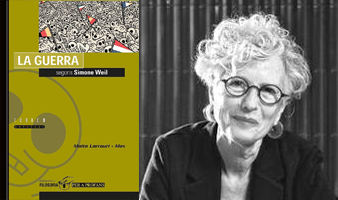
Sense obstacles no hi ha llibertat.

Tan sols la imaginació, que és font d'enganys, ens pot fer creure que l'obstacle ens impedeix ser Iliures. Cadascú de nosaltres, en el seu fur intern, tendeix a considerar-se el centre del món. I quan deixa que la imaginació el domine, el seu jo s'infla de forma desorbitada. Quin límit pot haver en el meu interior per a considerar-me la més llesta, la millor, la més guapa? Què pot impedir que en la meua imaginació anul·le tots els rivals possibles?

Quan se suprimeix realment un obstacle, tot i que s'estiga cometent un crim real, es tracta d'una supressió imaginària, perquè únicament la imaginació pot creure que sense això que anomena "obstacles a la seua Ilibertat" es puga arribar a ser lliure. Com si el vaixell pogués existir sense mar ni sense vent. A Simone Weil li agradava citar en les seues classes de filosofia la frase de Kant: «La coloma lleugera, quan en el seu vol Iliure sent la resistència de l'aire que solca, podria imaginar-se que encara ho faria millor en el buit».

Outrunning the Sun

If you visit Christ Church College at Oxford University, you might notice something rather strange among the fabled ‘dreaming spires’: the clocks are wrong. Or, rather, the clocks are right.

It’s not a huge difference. The clocks are just five minutes and two seconds behind Greenwich Mean Time – time as measured at the Royal Observatory in Greenwich, London, which forms the basis of the Coordinated Universal Time (UTC) used around the world. That five-minute gap exists because Oxford lies west of the Prime Meridian, the line of 0° longitude that runs through Greenwich. The further from London you go, the further ahead or behind UTC the local solar time becomes. In Cornwall, the sundial was more than a quarter of an hour behind Greenwich.

I say ‘was’, because in the 19th century everything changed. Technology transformed our relationship to space, and time was dragged along with it.

In Being and Time – that hand-grenade thrown into 20th century European philosophy – Martin Heidegger wrote that “initially, ‘time’ shows itself in the sky, that is, precisely where one finds it in the natural orientation towards it, so that ‘time’ is even identified with the sky.” For most of human history, to ask the time was to ask a question about the Sun. Indeed, such a question was probably rare, for nobody really needed to know the minute. People lived by the hours of the day and the ebb and flow of the seasons.

We still created calendars, of course, and a roster of feasts and holidays – events that unify what Charles Taylor called “high time” and “profane time”, the time of the sacred and the time of everyday work and rest. But even these were still linked to the accidents of the orbit of the planet and the positions of celestial bodies. Time was structured by rhythms and cycles that had their origins in the tilt and rotation of the Earth, rather than any more distinctively human project.

As evolved creatures, we are embodied to the effects of these cosmic accidents. The Sun is buried deep in our biology. We rise and sleep with circadian rhythms that betray our identity as animals living on a planet that turns on its axis once every twenty-four hours. On the plains of Africa, our distant ancestors could simply never move fast enough to experience jetlag; never had to forego sleep in order to communicate with anyone in a different time zone. They could outwit predators and prey alike, but they could never outrun the Sun.

But it’s different for us. New technologies changed things. It appears most people used to fall asleep for about four hours, wake for an hour or two deep in the night, and then sleep for another four. But street lighting and candles made it possible to fight the darkness for longer, so a single long period of sleep became the default. Interestingly, though, experimental data suggests that if people are kept in the dark for fourteen hours a day, the old two-part sleeping pattern seems to re-emerge.

With the coming of the factory, time was turned into a commodity, carved up and sold in increments. A new question became possible: “Do you have the time?” – a question that faintly alludes to a sense in which the speaker has lost the time, through time’s being made more precise than the sky and the body can provide.

If you visit Christ Church College at Oxford University, you might notice something rather strange among the fabled ‘dreaming spires’: the clocks are wrong. Or, rather, the clocks are right.

It’s not a huge difference. The clocks are just five minutes and two seconds behind Greenwich Mean Time – time as measured at the Royal Observatory in Greenwich, London, which forms the basis of the Coordinated Universal Time (UTC) used around the world. That five-minute gap exists because Oxford lies west of the Prime Meridian, the line of 0° longitude that runs through Greenwich. The further from London you go, the further ahead or behind UTC the local solar time becomes. In Cornwall, the sundial was more than a quarter of an hour behind Greenwich.

I say ‘was’, because in the 19th century everything changed. Technology transformed our relationship to space, and time was dragged along with it.

In Being and Time – that hand-grenade thrown into 20th century European philosophy – Martin Heidegger wrote that “initially, ‘time’ shows itself in the sky, that is, precisely where one finds it in the natural orientation towards it, so that ‘time’ is even identified with the sky.” For most of human history, to ask the time was to ask a question about the Sun. Indeed, such a question was probably rare, for nobody really needed to know the minute. People lived by the hours of the day and the ebb and flow of the seasons.

We still created calendars, of course, and a roster of feasts and holidays – events that unify what Charles Taylor called “high time” and “profane time”, the time of the sacred and the time of everyday work and rest. But even these were still linked to the accidents of the orbit of the planet and the positions of celestial bodies. Time was structured by rhythms and cycles that had their origins in the tilt and rotation of the Earth, rather than any more distinctively human project.

As evolved creatures, we are embodied to the effects of these cosmic accidents. The Sun is buried deep in our biology. We rise and sleep with circadian rhythms that betray our identity as animals living on a planet that turns on its axis once every twenty-four hours. On the plains of Africa, our distant ancestors could simply never move fast enough to experience jetlag; never had to forego sleep in order to communicate with anyone in a different time zone. They could outwit predators and prey alike, but they could never outrun the Sun.

But it’s different for us. New technologies changed things. It appears most people used to fall asleep for about four hours, wake for an hour or two deep in the night, and then sleep for another four. But street lighting and candles made it possible to fight the darkness for longer, so a single long period of sleep became the default. Interestingly, though, experimental data suggests that if people are kept in the dark for fourteen hours a day, the old two-part sleeping pattern seems to re-emerge.

With the coming of the factory, time was turned into a commodity, carved up and sold in increments. A new question became possible: “Do you have the time?” – a question that faintly alludes to a sense in which the speaker has lost the time, through time’s being made more precise than the sky and the body can provide.

It’s easy to think we should resist this shift somehow, and reclaim time as a lived experience of sky and body instead of an artificial, mathematical structuring of our days, years, and lives. Those deliberately slow clocks in Oxford are a charming little act of rebellion against the divorce of clock-time and sky-time. Our sun-programmed body, after all, has a habit of reasserting itself against clock-time, as anyone who has laid sleepless in a foreign city after a long flight can tell you. (Insomnia, said Levinas, is sheer awareness of being as such, a state of watchfulness without an object. It also, we might add, sucks). Jetlag is a reminder that we’re moving at velocities far greater than our ancestors on the plains ever could.

But instead of fighting it, some reformers suggest we should just finish what we started two centuries ago. Aviation, for instance, largely works on ‘Zulu Time’ i.e. UTC. So why not simply use one time zone for the whole world?

That would take some getting used to, of course. For the first time, ‘midday’ and ‘12pm’ would be very different things everywhere but London. Depending where you live you might be watching the dawn at 11pm or snuggling into bed at 11am. Yet we’re already used to clock-time diverging from the sky given the shorter days of winter and the long twilights of summer, and the change to daylight saving time and back. Perhaps it wouldn’t be that much of a shift.

Still, don’t be surprised if the old rhythms continue to haunt us even as our technological powers increase. No matter how fast we manage to live, we’re still creatures of the Sun.

PS.png

Unplan.

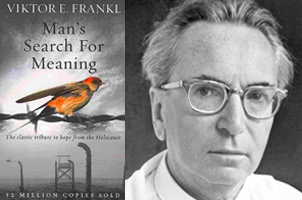
Don’t aim at success — the more you aim at it and make it a target, the more you are going to miss it. For success, like happiness, cannot be pursued; it must ensue, and it only does so as the unintended side-effect of one’s dedication to a cause greater than oneself or as the by-product of one’s surrender to a person other than oneself. Happiness must happen, and the same holds for success: you have to let it happen by not caring about it. I want you to listen to what your conscience commands you to do and go on to carry it out to the best of your knowledge. Then you will live to see that in the long run—in the long run, I say!—success will follow you precisely because you had forgotten to think of it.

NYC

It was 1978. I was new to New York. A rich acquaintance had invited me to a housewarming party, and, as my cabdriver wound his way down increasingly potholed and dingy streets, I began wondering whether he'd got the address right. Finally he stopped at the doorway of a gloomy, unwelcoming industrial building. Two winos were crumpled on the steps, oblivious. There was no other sign of life in the whole street.

"I think you may have made a mistake", I ventured.

But he hadn't. My friend's voice called "Top Floor!" when I rang the bell, and I thought - knowing her sense of humour - "Oh this is going to be some kind of joke!" I was all ready to laugh. The elevator creaked and clanked slowly upwards, and I stepped out - into a multi-million dollar palace. The contrast with the rest of the building and the street outside couldn't have been starker.

I just didn't understand. Why would anyone spend so much money building a place like that in a neighbourhood like this? Later I got into conversation with the hostess. "Do you like it here?" I asked. "It's the best place I've ever lived", she replied. "But I mean, you know, is it an interesting neighbourhood?" "Oh, the neighbourhood? Well that's outside!" she laughed.

The incident stuck in my mind. How could you live so blind to your surroundings? How could you not think of where I live as including at least some of the space outside your four walls, some of the bits you couldn't lock up behind you? I felt this was something particular to New York: I called it "The Small Here". I realised that, like most Europeans, I was used to living in a bigger Here.

I noticed that this very local attitude to space in New York paralleled a similarly limited attitude to time. Everything was exciting, fast, current, and temporary. Enormous buildings came and went, careers rose and crashed in weeks. You rarely got the feeling that anyone had the time to think two years ahead, let alone ten or a hundred. Everyone seemed to be passing through. It was undeniably lively, but the downside was that it seemed selfish, irresponsible and randomly dangerous. I came to think of this as "The Short Now", and this suggested the possibility of its opposite - "The Long Now".

"Now" is never just a moment. The Long Now is the recognition that the precise moment you're in grows out of the past and is a seed for the future. The longer your sense of Now, the more past and future it includes. It's ironic that, at a time when humankind is at a peak of its technical powers, able to create huge global changes that will echo down the centuries, most of our social systems seem geared to increasingly short nows. Huge industries feel pressure to plan for the bottom line and the next shareholders meeting. Politicians feel forced to perform for the next election or opinion poll. The media attract bigger audiences by spurring instant and heated reactions to human interest stories while overlooking longer-term issues - the real human interest.

Meanwhile, we struggle to negotiate our way through an atmosphere of Utopian promises and dystopian threats, a minefield studded with pots of treasure. We face a future where almost anything could happen. Will we be crippled by global warming, weapons proliferation and species depletion, or liberated by space travel, world government and molecule-sized computers? We don't even want to start thinking about it. This is our peculiar form of selfishness, a studied disregard of the future. Our astonishing success as a technical civilisation has led us to complacency, to expect that things will probably just keep getting better.

But there is no reason to believe this. We might be living in the last gilded bubble of a great civilisation about to collapse into a new Dark Age, which, given our hugely amplified and widespread destructive powers, could be very dark indeed.

If we want to contribute to some sort of tenable future, we have to reach a frame of mind where it comes to seem unacceptable - gauche, uncivilised - to act in disregard of our descendants. Such changes of social outlook are quite possible - it wasn't so long ago, for example, that we accepted slavery, an idea which most of us now find repellent. We felt no compulsion to regard slaves as fellow-humans and thus placed them outside the circle of our empathy. This changed as we began to realise, perhaps it was partly the glory of their music, that they were real people, and that it was no longer acceptable that we should cripple their lives just so that ours could be freer. It just stopped feeling right.

The same type of change happened when we stopped employing kids to work in mines, or when we began to accept that women had voices too. Today we view as fellow-humans many whom our grandparents may have regarded as savages, and even feel some compulsion to share their difficulties - aid donations by individuals to others they will never meet continue to increase. These extensions of our understanding of who qualifies for our empathy, indicate that culturally, economically and emotionally we live in an increasingly Big Here, unable to lock a door behind us and pretend the rest of the world is just "outside".

We don't yet, however, live in The Long Now. Our empathy doesn't extend far forward in time. We need now to start thinking of our great-grandchildren, and their great-grandchildren, as other fellow-humans who are going to live in a real world which we are incessantly, though only semi-consciously, building. But can we accept that our actions and decisions have distant consequences, and yet still dare do anything? It was an act of complete faith to believe, in the days of slavery, that a way of life which had been materially very successful could be abandoned and replaced by another, as yet unimagined, but somehow it happened. We need to make a similar act of imagination now.

Since this act of imagination concerns our relationship to time, a Millennium is a good moment to articulate it. Can we grasp this sense of ourselves as existing in time, part of the beautiful continuum of life? Can we become inspired by the prospect of contributing to the future? Can we shame ourselves into thinking that we really do owe those who follow us some sort of consideration, just as the people of the nineteenth century shamed themselves out of slavery? Can we extend our empathy to the lives beyond ours?

I think we can. Humans are capable of a unique trick: creating realities by first imagining them, by experiencing them in their minds. When Martin Luther King said "I have a dream", he was inviting others to dream it with him. Once a dream becomes shared in that way, current reality gets measured against it and then modified towards it. As soon as we sense the possibility of a more desirable world, we begin behaving differently, as though that world is starting to come into existence, as though, in our minds at least, we're already there. The dream becomes an invisible force which pulls us forward. By this process it starts to come true. The act of imagining something makes it real.

This imaginative process can be seeded and nurtured by artists and designers, for, since the beginning of the 20th century, artists have been moving away from an idea of art as something finished, perfect, definitive and unchanging towards a view of artworks as processes or the seeds for processes - things that exist and change in time, things that are never finished. Sometimes this is quite explicit - as in Walter de Maria's "Lightning Field", a huge grid of metal poles designed to attract lightning. Many musical compositions don't have one form, but change unrepeatingly over time - many of my own pieces and Jem Finer's Artangel installation "LongPlayer" are like this. Artworks in general are increasingly regarded as seeds - seeds for processes that need a viewer's (or a whole culture's) active mind in which to develop. Increasingly working with time, culture-makers see themselves as people who start things, not finish them.

And what is possible in art becomes thinkable in life. We become our new selves first in simulacrum, through style and fashion and art, our deliberate immersions in virtual worlds. Through them we sense what it would be like to be another kind of person with other kinds of values. We rehearse new feelings and sensitivities. We imagine other ways of thinking about our world and its future.

Danny Hillis's Clock of the Long Now is a project designed to achieve such a result. It is, on the face of it, far-fetched to think that one could make a clock which will survive and work for the next 10,000 years. But the act of even trying is valuable: it puts time and the future on the agenda and encourages thinking about them. As Stewart Brand, a colleague in The Long Now Foundation, says:

“Such a clock, if sufficiently impressive and well engineered, would embody deep time for people. It should be charismatic to visit, interesting to think about, and famous enough to become iconic in the public discourse. Ideally, it would do for thinking about time what the photographs of Earth from space have done for thinking about the environment. Such icons reframe the way people think.

The 20th Century yielded its share of icons, icons like Muhammad Ali and Madonna that inspired our attempts at self-actualisation and self-reinvention. It produced icons to our careless and misdirected power - the mushroom cloud, Auschwitz, and to our capacity for compassion - Live Aid, the Red Cross.

In this, the 21st century, we may need icons more than ever before. Our conversation about time and the future must necessarily be global, so it needs to be inspired and consolidated by images that can transcend language and geography. As artists and culture-makers begin making time, change and continuity their subject-matter, they will legitimise and make emotionally attractive a new and important conversation.

BE.jpg

Animal rights vs. biblical literalism and unbridled science.

Another fundamental error of Christianity is that it has in an unnatural fashion sundered mankind from the animal world to which it essentially belongs and now considers mankind alone as of any account, regarding the animals as no more than things. This error is a consequence of creation out of nothing, after which the Creator, in the first and second chapters of Genesis, takes all the animals just as if they were things, and without so much as the recommendation of kind treatment which even a dog-seller usually adds when he parts with his dogs, hands them over to man for man to rule, that is to do with them what he likes; subsequently, in the second chapter, the Creator goes on to appoint him the first professor of zoology by commissioning him to give the animals the names they shall thenceforth bear, which is once more only a symbol of their total dependence on him, i.e their total lack of rights.

It can truly be said: Men are the devils of the earth, and the animals are the tormented souls. This is the consequence of that installation scene in the Garden of Eden. For the mob can be controlled only by force or by religion, and here Christianity leaves us shamefully in the lurch. I heard from a reliable source that a Protestant pastor, requested by an animal protection society to preach a sermon against cruelty to animals, replied that with the best will in the world he was unable to do so, because he could find no support in his religion. The man was honest, and he was right.

When I was studying at Göttingen, Blumenbach spoke to us very seriously about the horrors of vivisection and told us what a cruel and terrible thing it was; wherefore it should be resorted to only very seldom and for very important experiments which would bring immediate benefit, and even then it must be carried out as publicly as possible so that the cruel sacrifice on the altar of science should be of the maximum possible usefulness. Nowadays, on the contrary, every little medicine-man thinks he has the right to torment animals in the cruellest fashion in his torture chamber so as to decide problems whose answers have for long stood written in books into which he is too lazy and ignorant to stick his nose. – Special mention should be made of an abomination committed by Baron Ernst von Bibra at Nürnberg and, with incomprehensible naïveté, tanquam re bene gesta, [As if the thing were done well] narrated by him to the public in his Vergleichende Untersuchungen über das Gehirn des Menschen und der Wirbelthiere: he deliberately let two rabbits starve to death! – in order to undertake the totally idle and useless experiment of seeing whether starvation produces a proportional change in the chemical composition of the brain! For the ends of science – n'est-ce pas? Have these gentlemen of the scalpel and crucible no notion at all then that they are first and foremost men, and chemists only secondly? How can you sleep soundly knowing you have harmless animals under lock and key in order to starve them slowly to death? Don't you wake up screaming in the night?

It is obviously high time that the Jewish conception of nature, at any rate in regard to animals, should come to an end in Europe, and that the eternal being which, as it lives in us, also lives in every animal should be recognized as such, and as such treated with care and consideration. One must be blind, deaf and dumb, or completely chloroformed by the foetor judaicus, not to see that the animal is in essence absolutely the same thing that we are, and that the difference lies merely in the accident, the intellect, and not in the substance, which is the will.

The greatest benefit conferred by the railways is that they spare millions of draught-horses their miserable existence.

AS.png

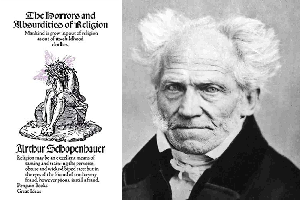
Arthur Schopenhauer (1788-1860) The Horrors and Absurdities of Religion

The path is the goal.

Para sanar o solucionar un problema se necesita una férrea voluntad. No poder hacer lo que deseamos ni poder no hacer lo que no deseamos, nos provoca una falta de autoestima profunda, causa de depresiones y enfermedades graves. El luchar incansablemente por lograr una meta que parece imposible desarrolla nuestra energía vital. Esto lo comprendieron muy bien los hechiceros medievales, creando recetarios que proponían actos imposibles de realizar, como por ejemplo un método para hacerse invisible. «Ponga a hervir un caldero de agua bendita con leña de vides blancas. Sumerja dentro un gato negro vivo, dejándolo cocer hasta que los huesos se aparten de la carne. Extraiga esos huesos con una estola de obispo y colóquese delante de una lámina de plata bruñida. Métase hueso tras hueso del gato escaldado en la boca, hasta que su imagen desaparezca del espejo de plata.» O bien un filtro para seducir a un hombre: «En un vaso modelado a mano con el barro que ha excavado el hocico de un jabalí, mezcle sangre de perro con sangre de gato más su sangre menstrual, agregue una perla molida y dele de beber a su amado diez gotas de este brebaje disueltas en una copa de vino». En el primer consejo, podríamos pensar que quizás no se habla de invisibilidad material, sino que quien debe hacerse transparente es el yo individual del aspirante a brujo. Después de tanto empeño en realizar algo tan cruel y dificil, se esfuma la personalidad individual y aparece el ser esencial, que es por esencia impersonal. En el segundo consejo cabe imaginar que si la bruja, por amor a un hombre, logra encontrar barro removido por un jabalí, asesinar a un perro, a un gato, y sacrificar dinero haciendo polvo una perla, despierta en ella tal seguridad en sí misma que se hace capaz de seducir a un ciego sordomudo. 

Ciertas curaciones en lugares lejanos declarados milagrosos son en gran parte debidas al largo y costoso viaje que debe hacer el enfermo para llegar a ellos.

aj.png

Everybody worships.

The only choice we get is what to worship. And an outstanding reason for choosing some sort of god or spiritual-type thing to worship–be it J.C. or Allah, be it Yahweh or the Wiccan mother-goddess of the Four Noble Truths or some infrangible set of ethical principles–is that pretty much anything else you worship will eat you alive.
If you worship money and things–if they are where you tap real meaning in life–then you will never have enough. Never feel you have enough. It’s the truth.
Worship your own body and beauty and sexual allure and you will always feel ugly, and when time and age start showing, you will die a million deaths before they finally plant you.
On one level we all know this stuff already–it’s been codified as myths, proverbs, clichés, bromides, epigrams, parables: the skeleton of every great story. The trick is keeping the truth up front in daily consciousness.
Worship power–you will feel weak and afraid, and you will need even more power over others to keep the fear at bay.
Worship your intellect, being seen as smart–you will end up feeling stupid, always on the verge of being found out.
And so on.
Look, the insidious thing about these forms of worship is not that they’re evil or sinful; it is that they are unconscious. They are default settings. They’re the kind of worship you just gradually slip into, day after day, getting more and more selective about what you see and how you measure value without ever being fully aware that that’s what you’re doing.
And the so-called “real world” will not discourage you from operating on your default settings, because the so-called “real world” of men and money and power hums along quite nicely on the fuel of fear and contempt and frustration and craving and the worship of self.
Our own present culture has harnessed these forces ins ays that they have yielded extraordinary wealth and comfort and personal freedom. The freedom all to be lords of our tiny skull-sized kingdoms, alone at the centre of all creation. This kind of freedom has much to recommend it.
But of course there are all different kinds of freedom, and the kind that is most precious you will not hear much talked about in the great outside world of winning and achieving and displaying. The really important kind of freedom involves attention, and awareness, and discipline, and effort, and being able truly to care about other people and to sacrifice for them, over and over, in myriad petty little unsexy ways, every day.
That is real freedom.

Reality is disappearing.

The disappearance of God has left us facing reality and the ideal prospect of transforming this real world. And we have found ourselves confronted with the undertaking of realizing the world, of making it become technically, integrally real.

···

Now, the world, even freed from all illusion, does not lend itself at all to reality. The more we advance in this undertaking, the more ambiguous it becomes, the more it loses sight of itself. Reality has barely had time to exist and already it is disappearing…

It is the excess of reality that makes us stop believing in it. The saturation of the world, the technical saturation of life, the excess of possibilities, of actualization of needs and desires. How are we to believe in reality once its production has become automatic?

The real is suffocated by its own accumulation. There is no way now for the dream to be an expression of a desire since its virtual accomplishment is already present.

Deprivation of dreams, deprivation of desire. And we know what mental disorder sleep deprivation induces.

Deep down, the problem is the same as with the ‘accursed share’: the problem of the surplus – not the lack, but the excess of reality – of which we no longer know how to rid ourselves.

There is no longer any symbolic resolution, by sacrifice, of the surplus, except in accidents or by the irruption of an anomic violence which, whatever its social or political determinations, is always a challenge to this irresistible objective constraint of a normalized world.

···

The eclipse of God left us up against reality. Where will the eclipse of reality leave us?