Dr Stranger Love: How I Learned to Stop Worrying and Love the Singularity

The true future of humanity lies not just in our species bidding farewell to Earth and expanding outward into space, but also in slipping the bonds of the “real world” and expanding inward into countless strange and strangely rewarding virtual worlds of our own design. If all of reality can plausibly be designed by computers and artificial intelligence, and if a simulated mode of reality can theoretically become more real than natural reality, then we owe it to ourselves and our society to delve as deeply as possible into those digital frontiers.

(…)

Perhaps this scenario reminds you of The Matrix, and those films’ visions of endless fields of humans kept alive in pods, unaware that their brains are connected to a computer simulation. But I would submit that the dystopian thing about this premise isn’t that trillions of humans might live their lives wholly inside cyberspace, but that they were forced there by hostile robots that had designed the simulation as a control mechanism. I believe that, in the future, plenty of people will choose to connect directly to a simulation as a means of pursuing peak fulfillment. Why does that seem like a bad thing?
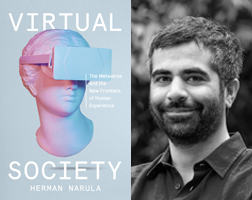
Narula, H. (2022) Virtual society: The metaverse and the new frontiers of human experience. London, UK: Penguin Business.

Reality is disappearing.

The disappearance of God has left us facing reality and the ideal prospect of transforming this real world. And we have found ourselves confronted with the undertaking of realizing the world, of making it become technically, integrally real.

···

Now, the world, even freed from all illusion, does not lend itself at all to reality. The more we advance in this undertaking, the more ambiguous it becomes, the more it loses sight of itself. Reality has barely had time to exist and already it is disappearing…

It is the excess of reality that makes us stop believing in it. The saturation of the world, the technical saturation of life, the excess of possibilities, of actualization of needs and desires. How are we to believe in reality once its production has become automatic?

The real is suffocated by its own accumulation. There is no way now for the dream to be an expression of a desire since its virtual accomplishment is already present.

Deprivation of dreams, deprivation of desire. And we know what mental disorder sleep deprivation induces.

Deep down, the problem is the same as with the ‘accursed share’: the problem of the surplus – not the lack, but the excess of reality – of which we no longer know how to rid ourselves.

There is no longer any symbolic resolution, by sacrifice, of the surplus, except in accidents or by the irruption of an anomic violence which, whatever its social or political determinations, is always a challenge to this irresistible objective constraint of a normalized world.

···

The eclipse of God left us up against reality. Where will the eclipse of reality leave us?