The truth about reality.

Reality is everything that exists. That sounds straightforward, doesn’t it? Actually, it isn’t. There are various problems. What about dinosaurs, which once existed but exist no longer? What about stars, which are so far away that, by the time their light reaches us and we can see them, they may have fizzled out?

We’ll come to dinosaurs and stars in a moment. But in any case, how do we know things exist, even in the present? Well, our five senses – sight, smell, touch, hearing and taste – do a pretty good job of convincing us that many things are real: rocks and camels, newly mown grass and freshly ground coffee, sandpaper and velvet, waterfalls and doorbells, sugar and salt. But are we only going to call something ‘real’ if we can detect it directly with one of our five senses?

What about a distant galaxy, too far away to be seen with the naked eye? What about a bacterium, too small to be seen without a powerful microscope? Must we say that these do not exist because we can’t see them? No. Obviously we can enhance our senses through the use of special instruments: telescopes for the galaxy, microscopes for bacteria. Because we understand telescopes and microscopes, and how they work, we can use them to extend the reach of our senses – in this case, the sense of sight – and what they enable us to see convinces us that galaxies and bacteria exist.

How about radio waves? Do they exist? Our eyes can’t detect them, nor can our ears, but again special instruments – television sets, for example – convert them into signals that we can see and hear. So, although we can’t see or hear radio waves, we know they are a part of reality. As with telescopes and microscopes, we understand how radios and televisions work. So they help our senses to build a picture of what exists: the real world – reality. Radio telescopes (and X-ray telescopes) show us stars and galaxies through what seem like different eyes: another way to expand our view of reality.

Back to those dinosaurs. How do we know that they once roamed the Earth? We have never seen them or heard them or had to run away from them. Alas, we don’t have a time machine to show them to us directly. But here we have a different kind of aid to our senses: we have fossils, and we can see them with the naked eye. Fossils don’t run and jump but, because we understand how fossils are formed, they can tell us something of what happened millions of years ago. We understand how water, with minerals dissolved in it, seeps into corpses buried in layers of mud and rock. We understand how the minerals crystallize out of the water and replace the materials of the corpse, atom by atom, leaving some trace of the original animal’s form imprinted on the stone. So, although we can’t see dinosaurs directly with our senses, we can work out that they must have existed, using indirect evidence that still ultimately reaches us through our senses: we see and touch the stony traces of ancient life.

In a different sense, a telescope can work like a kind of time machine. What we see when we look at anything is actually light, and light takes time to travel. Even when you look at a friend’s face you are seeing them in the past, because the light from their face takes a tiny fraction of a second to travel to your eye. Sound travels much more slowly, which is why you see a firework burst in the sky noticeably earlier than you hear the bang. When you watch a man chopping down a tree in the distance, there is an odd delay in the sound of his axe hitting the tree.

Light travels so fast that we normally assume anything we see happens at the instant we see it. But stars are another matter. Even the sun is eight light-minutes away. If the sun blew up, this catastrophic event wouldn’t become a part of our reality until eight minutes later. And that would be the end of us! As for the next nearest star, Proxima Centauri, if you look at it in 2012, what you are seeing is happening in 2008. Galaxies are huge collections of stars. We are in one galaxy called the Milky Way. When you look at the Milky Way’s next-door neighbour, the Andromeda galaxy, your telescope is a time machine taking you back two and a half million years. There’s a cluster of five galaxies called Stephan’s Quintet, which we see through the Hubble telescope spectacularly colliding with each other. But we see them colliding 280 million years ago. If there are aliens in one of those colliding galaxies with a telescope powerful enough to see us, what they are seeing on Earth, at this very moment, here and now, is the early ancestors of the dinosaurs.

Are there really aliens in outer space? We’ve never seen or heard them. Are they a part of reality? Nobody knows; but we do know what kind of things could one day tell us if they are. If ever we got near to an alien, our sense organs could tell us about it. Perhaps somebody will one day invent a telescope powerful enough to detect life on other planets from here. Or perhaps our radio telescopes will pick up messages that could only have come from an alien intelligence. For reality doesn’t just consist of the things we already know about: it also includes things that exist but that we don’t know about yet and won’t know about until some future time, perhaps when we have built better instruments to assist our five senses.

Atoms have always existed, but it was only rather recently that we became sure of their existence, and it is likely that our descendants will know about many more things that, for now, we do not. That is the wonder and the joy of science: it goes on and on uncovering new things. This doesn’t mean we should believe just anything that anybody might dream up: there are a million things we can imagine but which are highly unlikely to be real – fairies and hobgoblins, leprechauns and hippogriffs. We should always be open-minded, but the only good reason to believe that something exists is if there is real evidence that it does.


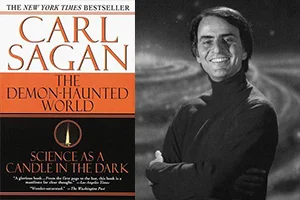
51dcC45R67L._SX326_BO1,204,203,200_.jpg

Fictions and facts.

A picture hung on the wall of our parlor. In it, a woman was taking a shirt from a clothesline. She had clothespins in her teeth and it was windy and a boy was tugging at her dress. The woman looked like she was in a hurry and the whole scene gave me the idea that, just outside the frame, full, dark clouds were gathering. But that was not what it was. It was paint. So I decided right then and there to see the picture as it really was. I stared at the thing long and hard, trying to only see the paint. But it was no use. All my eyes would allow me to see was the lie. In fact, the longer I gazed at the paint, the more false detail I began to imagine. The boy was crying, as if afraid, and the woman was weaker than I had first believed. I finally gave up. I understood then that it takes a powerful imagination to see a thing for what it really is.

(...)

Death is a funny thing. Not funny haha, like a Woody Allen movie, but funny strange, like a Woody Allen marriage. When it’s unexpected, death comes fast like a ravenous wolf and tears open your throat with a merciful fury. But when it’s expected, it comes slow and patient like a snake, and the doctor tells you how far away it is and when, exactly, it will be at your door. And when it will be at the foot of your bed. And when it will be on your flesh. It’s all right there on their clipboards.

nm.png

A hurdle called truth.

Magic requires tacit cooperation of the audience with the magician--an abandonment of skepticism, or what is sometimes described as the willing suspension of disbelief.

---

It was a 1954 book I had read in college, The Fifty-Minute Hour. The author, a psychoanalyst named Robert Lindner, had been called by the Los Alamos National Laboratory to treat a brilliant young nuclear physicist whose delusional system was beginning to interfere with his secret government research. The physicist (given the pseudonym Kirk Allen) had, it turned out, another life besides making nuclear weapons: in the far future, he confided, he piloted (or will pilot - the tenses get a little addled) interstellar spacecraft. He enjoyed rousing, swashbuckling adventures on planets of other stars. He was "lord" of many worlds. Perhaps they called him Captain Kirk. Not only could he "remember" this other life; he could also enter into it whenever he chose. By thinking in the right way, by wishing, he could transport himself across the light years and the centuries.

In some way I could not comprehend, by merely desiring it to be so, I had crossed the immensities of space, broken out of time, and merged with - literally became - that distant and future self . . . Don't ask me to explain. I can't, although God knows I've tried.

Lindner found him intelligent, sensitive, pleasant, polite and perfectly able to deal with everyday human affairs. But, in reflecting on the excitement of his life among the stars, Allen had found himself a little bored with his life on Earth, even if it did involve building weapons of mass destruction. When admonished by his laboratory supervisors for distraction and dreaminess, he apologized; he would try, he assured them, to spend more time on this planet. That's when they contacted Lindner. 

Allen had written 12,000 pages on his experiences in the future, and dozens of technical treatises on the geography, politics, architecture, astronomy, geology, life forms, genealogy and ecology of the planets of other stars. A flavour of the material is given by these monograph titles: "The Unique Brain Development of the Chrystopeds of Srom Norba X", "Fire Worship and Sacrifice on Srom Sodrat II", "The History of the Intergalactic Scientific Institute", and "The Application of Unified Field Theory and the Mechanics of the Stardrive to Space Travel". (That last is the one I'd like to see; after all, Allen was said to have been a first-rate physicist.) Fascinated, Lindner pored over the material. 

Allen was not in the least shy about presenting his writings to Lindner or discussing them in detail. Unflappable and intellectually formidable, he seemed not to be yielding an inch to Lindner's psychiatric ministrations. When everything else failed, the psychiatrist attempted something different:

I tried . . . to avoid giving in any way the impression that I was entering the lists with him to prove that he was psychotic, that this was to be a tug of war over the question of his sanity. Instead, because it was obvious that both his temperament and training were scientific, I set myself to capitalize on the one quality he had demonstrated throughout his life . . . the quality that urged him toward a scientific career: his curiosity .. . This meant . . . that at least for the time being I 'accepted' the validity of his experiences . . . In a sudden flash of inspiration it came to me that in order to separate Kirk from his madness it was necessary for me to enter his fantasy and, from that position, to pry him loose from the psychosis.

Lindner highlighted certain apparent contradictions in the documents and asked Allen to resolve them. This required the physicist to re-enter the future to find the answers. Dutifully, Allen would arrive at the next session with a clarifying document written in his neat hand. Lindner found himself eagerly awaiting each interview, so he could be once more captivated by the vision of abundant life and intelligence in the galaxy. Between them, they were able to resolve many problems of consistency. 

Then a strange thing happened: "The materials of Kirk's psychosis and the Achilles heel of my personality met and meshed like the gears of a clock." The psychoanalyst became a co-conspirator in his patient's delusion. He began to reject psychological explanations of Allen's story. How sure are we that it couldn't really be true? He found himself defending the notion that another life, that of a spacefarer in the far future, could be entered into by a simple effort of the will. 

At a startlingly rapid rate . . . larger and larger areas of my mind were being taken over by the fantasy . . . With Kirk's puzzled assistance I was taking part in cosmic adventures, sharing the exhilaration of the sweeping extravaganza he had plotted. 

But eventually, an even stranger thing happened: concerned for the well-being of his therapist, and mustering admirable reserves of integrity and courage, Kirk Allen confessed: he had made the whole thing up. It had roots in his lonely childhood and his unsuccessful relationships with women. He had shaded, and then forgotten, the boundary between reality and imagination. Filling in plausible details and weaving a rich tapestry about other worlds was challenging and exhilarating. He was sorry he had led Lindner down this primrose path. 

"Why," the psychiatrist asked, "why did you pretend? Why did you keep on telling me . . .?" 

"Because I felt I had to," the physicist replied. "Because I felt you wanted me to."

Kirk and I reversed roles, Lindner explained, and, in one of those startling denouements that make my work the unpredictable, wonderful and rewarding pursuit it is, the folly we shared collapsed . . . I employed the rationalization of clinical altruism for personal ends and thus fell into a trap that awaits all unwary therapists of the mind . . . Until Kirk Allen came into my life, I had never doubted my own stability. The aberrations of mind, so I had always thought, were for others . . . I am ashamed by this smugness. But now, as I listen from my chair behind the couch, I know better. I know that my chair and the couch are separated only by a thin line. I know that it is, after all, but a happier combination of accidents that determines, finally, who shall lie on the couch, and who shall sit behind it.