Real Free Speech.

Cooperating instead of competing. Telling instead of lecturing. Listening instead of eavesdropping. Compassion not judgment. Acceptance not censorship. Celebrating identities not shaming. Risking exposure, not hiding. Paying attention instead of zoning out.

That is what makes community storytelling unique and transformational. But what makes it radical?

For one thing, the pure democracy of it all. The essential structure provides all storytellers an equal opportunity to take to the stage and tell about real things that happened to them, things they saw and did, things that they want to share with a roomful of strangers. It’s a place where everyday folks, with different life experiences, joys and sorrows, have a voice. Providing a venue and audience for this sort of activity could be seen as downright subversive. Nothing is canned, predictable or especially polite. It can be raw. mean or sugary sweet depending on who is brave enough to commit to a rehearsal, have their name and bio go out over social media, and show up for the event.

The structure inspires honesty and confessional tales. Intimacy emerges from the bare bones of a stage, a mic, a teller and listeners. One night at an Odyssey Storytelling show a woman, whose mother sat in the audience, confessed to sneaking out of her second story bedroom window, undetected, when she was a teenager. Twenty years later, Mom laughed at the story along with everyone else.

Stories about shame, triumph, and prejudice; love, revenge, and greed; all presented on a neutral stage, inviting deep respect and listening. I’ve never seen nor heard anyone being confrontational, although sometimes people are shocked or confused. If you weren’t expecting to hear about the sex life of a transman, it might take a moment or two to adjust your expectations and relax into serious appreciation.

Exposure = understanding = acceptance = true connection

Radically changing minds and hearts is just one of many advantages of community storytelling. Shaking people out of their insular lives and dropping them into another reality is radical. Community Storytelling is a place where diversity is celebrated and lessons are learned in the best possible le way—from people who are different from us. By listening fiercely and intensely, we allow ourselves to be amused or scared or made joyful; we open up to new possibilities. As the Tucson Meet Yourself 40th Anniversary Commemorative Magazine so aptly put it, “The messiness of cultures bumping into each other is the messiness of democracy—the elusive aspiration of equality, justice, and respect.”

Infusing storytellers with self-confidence and the knowledge that their stories matter is radical. Exposing tellers to nonjudgmental witnesses who validate their experience by offering kindness in exchange for honesty/trust subverts the paradigm of separateness and competition. For two hours, the length of a show, a community is created. And there is spillover—friendships are forged, connections happen, overlapping social networks will amaze and make us say, “But, of course.”

The Mythmaker

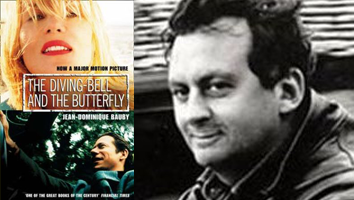
On the benches of the Paris school where I wore out my first pair of jeans I made friends with a skinny red-faced boy named Olivier, whose runaway mythomania made his company irresistible. With him around, there was no need to go to the movies. Olivier’s friends had the best seats in the house, and the film was a miracle of invention. On Monday he would amaze us with a weekend saga straight out of the Thousand and One Nights. If he had not spent Sunday with Johnny Hallyday it was because he had gone to London to see the new James Bond, unless he had been driving the latest Honda. (Japanese motorbikes, just then arriving in France, were all the rage in schoolyard discussions.) From morning to night our friend fed us small lies and gross fabrications, brazenly inventing new stories even when they contradicted preceding ones. An orphan at 10 a.m., an only son at noon, he could dig up four sisters by mid-afternoon, one of them a figure-skating champion. As for his father - in reality a sober civil servant - he became, depending on the day, the inventor of the atom bomb, the Beatles’ manager, or General de Gaulle’s unacknowledged son. Since Olivier himself neglected to give coherence to the dishes he served up, we would have been the last to expect consistency of him. When he came out with some utterly outlandish fable we would voice tentative doubts, but he defended his good faith with such indignant protest of ‘I swear!’ that we would swiftly back down.

When I last checked, Olivier was neither a fighter pilot nor a secret agent nor adviser to an Emir (careers he once considered). Fairly predictably, it is in the advertising world that he wields his inexhaustible faculty for gilding every lily.

Animal rights vs. biblical literalism and unbridled science.

Another fundamental error of Christianity is that it has in an unnatural fashion sundered mankind from the animal world to which it essentially belongs and now considers mankind alone as of any account, regarding the animals as no more than things. This error is a consequence of creation out of nothing, after which the Creator, in the first and second chapters of Genesis, takes all the animals just as if they were things, and without so much as the recommendation of kind treatment which even a dog-seller usually adds when he parts with his dogs, hands them over to man for man to rule, that is to do with them what he likes; subsequently, in the second chapter, the Creator goes on to appoint him the first professor of zoology by commissioning him to give the animals the names they shall thenceforth bear, which is once more only a symbol of their total dependence on him, i.e their total lack of rights.

It can truly be said: Men are the devils of the earth, and the animals are the tormented souls. This is the consequence of that installation scene in the Garden of Eden. For the mob can be controlled only by force or by religion, and here Christianity leaves us shamefully in the lurch. I heard from a reliable source that a Protestant pastor, requested by an animal protection society to preach a sermon against cruelty to animals, replied that with the best will in the world he was unable to do so, because he could find no support in his religion. The man was honest, and he was right.

When I was studying at Göttingen, Blumenbach spoke to us very seriously about the horrors of vivisection and told us what a cruel and terrible thing it was; wherefore it should be resorted to only very seldom and for very important experiments which would bring immediate benefit, and even then it must be carried out as publicly as possible so that the cruel sacrifice on the altar of science should be of the maximum possible usefulness. Nowadays, on the contrary, every little medicine-man thinks he has the right to torment animals in the cruellest fashion in his torture chamber so as to decide problems whose answers have for long stood written in books into which he is too lazy and ignorant to stick his nose. – Special mention should be made of an abomination committed by Baron Ernst von Bibra at Nürnberg and, with incomprehensible naïveté, tanquam re bene gesta, [As if the thing were done well] narrated by him to the public in his Vergleichende Untersuchungen über das Gehirn des Menschen und der Wirbelthiere: he deliberately let two rabbits starve to death! – in order to undertake the totally idle and useless experiment of seeing whether starvation produces a proportional change in the chemical composition of the brain! For the ends of science – n'est-ce pas? Have these gentlemen of the scalpel and crucible no notion at all then that they are first and foremost men, and chemists only secondly? How can you sleep soundly knowing you have harmless animals under lock and key in order to starve them slowly to death? Don't you wake up screaming in the night?

It is obviously high time that the Jewish conception of nature, at any rate in regard to animals, should come to an end in Europe, and that the eternal being which, as it lives in us, also lives in every animal should be recognized as such, and as such treated with care and consideration. One must be blind, deaf and dumb, or completely chloroformed by the foetor judaicus, not to see that the animal is in essence absolutely the same thing that we are, and that the difference lies merely in the accident, the intellect, and not in the substance, which is the will.

The greatest benefit conferred by the railways is that they spare millions of draught-horses their miserable existence.

AS.png

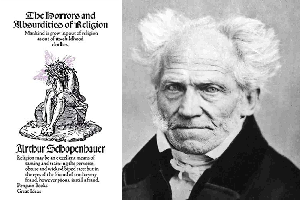
Arthur Schopenhauer (1788-1860) The Horrors and Absurdities of Religion