Prozac blues.

No matter how corrupt, greedy, and heartless our government, our corporations, our media, and our religious & charitable institutions may become, the music will still be wonderful.

If I should ever die, God forbid, let this be my epitaph:

THE ONLY PROOF HE NEEDED
FOR THE EXISTENCE OF GOD
WAS MUSIC

***

Back to music. It makes practically everybody fonder of life than he or she would be without it. Even military bands, although I am a pacifist, always cheer me up. And I really like Strauss and Mozart and all that, but the priceless gift that African Americans gave the whole world when they were still in slavery was a gift so great that it is now almost the only reason many foreigners still like us at least a little bit. That specific remedy for the worldwide epidemic of depression is a gift called the blues. All pop music today—jazz, swing, be-bop, Elvis Presley, the Beatles, the Stones, rock-and-roll, hip-hop, and on and on—is derived from the blues.
 
A gift to the world? One of the best rhythm-and-blues combos I ever heard was three guys and a girl from Finland playing in a club in Krakow, Poland.
 
The wonderful writer Albert Murray, who is a jazz historian and a friend of mine among other things, told me that during the era of slavery in this country—an atrocity from which we can never fully recover—the suicide rate per capita among slave owners was much higher than the suicide rate among slaves.
 
Murray says he thinks this was because slaves had a way of dealing with depression, which their white owners did not: They could shoo away Old Man Suicide by playing and singing the Blues. He says something else which also sounds right to me. He says the blues can't drive depression clear out of a house, but can drive it into the corners of any room where it's being played. 

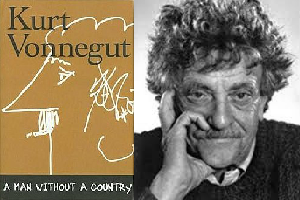
220px-AManWithoutACountry.jpg

Brain's the enemy.

Mary had also taught that the human brain was the most admirable survival device yet produced by evolution. But now her own big brain was urging her to take the polyethylene garment bag from around a red evening dress in her closet, and to wrap it around her head, thus depriving her cells of oxygen.

Before that, her wonderful brain had entrusted a thief at the airport with a suitcase containing all her toilet articles and clothes which would have been suitable for the hotel.

Her colossal thinking machine could be so petty, too. It would not let her go downstairs in her combat fatigues on the grounds that everybody, even though there was practically nobody in the hotel, would find her comical in such a costume. Her brain told her: ‘They’ll laugh at you behind your back, and think you’re crazy and pitiful, and your life is over anyway. You’ve lost your husband and your teaching job, and you don’t have any children or anything else to live for, so just put yourself out of your misery with the garment bag. What could be easier? What could be more painless? What could make more sense?’

Just about every adult human being back then had a brain weighing about three kilogrammes! There was no end to the evil schemes that a thought machine that oversized couldn’t imagine and execute. 

So I raise this question, although there is nobody around to answer it: Can it be doubted that three-kilogramme brains were once nearly fatal defects in the evolution of the human race?

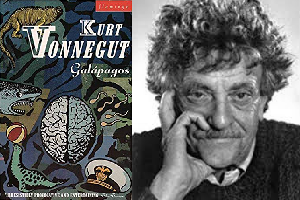
KV.png

On the conclusion of species.

El professor Jerison ha estudiat en profunditat l'evolució del cervell humà, i s'ha concentrat, sobretot, en els suposats avantatges d'un cervell molt desenvolupat en relació amb la grandària i el pes corporal. Amb tot, els neuròlegs afirmen que la depressió és una malaltia mental que només afecta els éssers que tenen la capacitat de reflexionar sobre si mateixos i de pensar en el seu passat i el seu futur. És a dir, que només es poden deprimir els humans perquè tenen un cervell gros. En aquest sentit, patim potser un excés de cervell?

Segons el famós psiquiatre britànic Tim Crow, hem de buscar l'origen de l'esquizofrènia en l'evolució dels cervells de majors dimensions. Crow afirma que l'esquizofrènia és el preu que paga l'Homo sapiens per tenir la capacitat del llenguatge. Aquesta idea és sens dubte suggeridora, però per a Jerison l'aspecte interessant és l'engrandiment del cervell, que suposa un nou salt evolutiu, d'una magnitud comparable al que va haver-hi fa 200 milions d'anys, quan en passar de rèptils a mamífers els animals van necessitar l'oïda i l'olfacte, a més de la vista.

«En l'evolució de tots els llinatges d'homínids, de l'australopitec en endavant, en un moment determinat va sorgir la necessitat de posseir un "mapa" més precís del territori que ocupaven, constituït ara per uns quants quilòmetres quadrats, i no solament uns quants metres quadrats, com en el cas del rèptil». Aquesta necessitat d'informació es troba en l'origen de l'engrandiment del cervell humà. Segons Jerison, això degué succeir quan el cervell humà tenia la grandària del d'un ximpanzé o una mica més, i l'evolució cap al llenguatge va venir de la necessitat de conèixer, reconèixer, un territori més extens. I del coneixement, i no pas de la grandària, ve la depressió. Perquè, com afirma Jerison no sense una certa ironia, «quan coneixem millor el món també ens coneixem millor a nosaltres amteixos i quan et coneixes a tu mateix, és molt probable que no t'agradis tant». Així, per a ell, l'esquizofrènia, la depressió, fins i tot els desordres bipolars podrien tenir l'origen en el millor coneixement de nosaltres mateixos. Un fet molt complex i en el qual influeixen multiples factors, entre els quals, saber que morirem, la renúncia a la immortalitat que va comportar el canvi del sistema de reproducció. La consciència de la mort ha significat un gran impuls en l'evolució. A excepció de l'home, no hi ha cap animal que la tingui. De manera que, ja ho veieu, quan parlem d'intel·ligència no tot són avantatges.

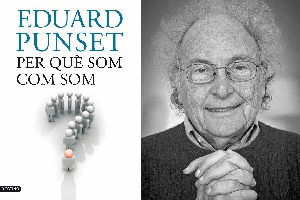
EP.png

Eduard Punset (2008) Per què som com som

"Life is very unpopular here."

The most horrible hypocrisy or the most terrifying hypocrisy or the most tragic hypocrisy at the center of life, I think, which no one dares mention, is that human beings don't like life. Bertrand Russell skirted that, and many psychoanalysts have too, in talking about people lusting for death. But I think that at least half the people alive, and maybe nine-tenths of them, really do not like this ordeal at all. They pretend to like it some, to smile at strangers, and to get up each morning in order to survive, in order to somehow get through it. But life is, for most people, a very terrible ordeal. They would just as soon end it at any time. And I think that is more of a problem really than greed or machismo or anything like that. You know, you talk about the dark side of life: that's really it. Most people don't want to be alive. They're too embarrassed, they're disgraced, they're frightened. I think that's the fundamental thing that's going on. Those of you with your devotion to peace and all that are actually facing people perhaps as brave and determined and resourceful and thoughtful as you are on some level. And what they really want to do is to have the whole thing turned off like a light switch.

(...)

When I'm engaged in any action I have to take into consideration that many of the people on either side of me don't care what happens next. I am mistrustful of most people as custodians Of life and so I'm pessimistic on that account. I think that there are not many people who want life to go on. And I'm just a bearer of bad tidings really. You know, I just got born myself and this is what I found on this particular planet. But life is very unpopular here, and maybe it will be different on the next one. 

(...)

It seems to me the whole world is living like Alcoholics Anonymous now, which is one day at a time, and it seems to me that President Carter is living that way too. Every night when he goes to bed he cackles, "By God, we made it through another day! Everybody said I was a lousy President, and here we've survived another day. That's not bad." We are living day by day by day now, but there seems to be very little restraint in the world. What an alcoholic does every day is not take a drink, and only not take a drink for a day. But I see no real restraint with regard to warlike actions. If we were truly interested in surviving, and having sobriety, each day we would congratulate ourselves not for merely having gotten through another day but for making it without a warlike gesture. But there is no such restraint. More weapons are manufactured every day and more arguments are gladly entered into and more enormous, dangerous lies are told, so there is no restraint. It would be truly wonderful if we could live as alcoholics do, to be unwarlike for just another day. We don't. We're totally warlike, and sooner or later something's going to go wrong. The book I'm working on now is about a kid, he's grown now, grown and in his 40s and his father was a gun nut. It was a house with dozens of guns in it. At the age of 11 this kid was playing with one of his father's guns, which he wasn't supposed to do, put a cartridge into a 30-06 rifle and fired out a goddamn attic window and killed a housewife, you know, eighteen blocks away, just drilled her right between the eyes. And this has colored his whole life, and made his reputation. And of course this weapon should not have existed. He was brought into a planet where this terribly unstable device existed, and all he had to do was sneeze near it. I mean, it wanted to be fired; it was built to be fired. It had no other purpose than to be fired and the existence of such an unstable device within the reach of any sort of human being is intolerable. 
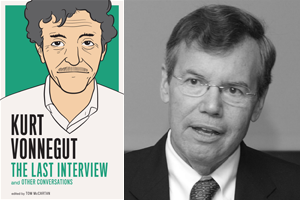
rm.png