Dr Stranger Love: How I Learned to Stop Worrying and Love the Singularity

The true future of humanity lies not just in our species bidding farewell to Earth and expanding outward into space, but also in slipping the bonds of the “real world” and expanding inward into countless strange and strangely rewarding virtual worlds of our own design. If all of reality can plausibly be designed by computers and artificial intelligence, and if a simulated mode of reality can theoretically become more real than natural reality, then we owe it to ourselves and our society to delve as deeply as possible into those digital frontiers.

(…)

Perhaps this scenario reminds you of The Matrix, and those films’ visions of endless fields of humans kept alive in pods, unaware that their brains are connected to a computer simulation. But I would submit that the dystopian thing about this premise isn’t that trillions of humans might live their lives wholly inside cyberspace, but that they were forced there by hostile robots that had designed the simulation as a control mechanism. I believe that, in the future, plenty of people will choose to connect directly to a simulation as a means of pursuing peak fulfillment. Why does that seem like a bad thing?

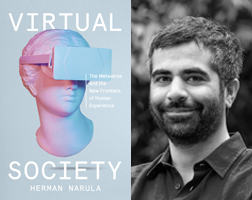
Narula, H. (2022) Virtual society: The metaverse and the new frontiers of human experience. London, UK: Penguin Business.

Xerox Life.

‘And what do you think? Do you suppose you can pull it off? Perform this role?’

‘It won’t be easy. But I believe if I continue to observe Josie carefully, it will be within my abilities.’

‘Then let me ask you something else. Let me ask you this. Do you believe in the human heart? I don’t mean simply the organ, obviously. I’m speaking in the poetic sense. The human heart. Do you think there is such a thing? Something that makes each of us special and individual? And if we just suppose that there is. Then don’t you think, in order to truly learn Josie, you’d have to learn not just her mannerisms but what’s deeply inside her? Wouldn’t you have to learn her heart?’

‘Yes, certainly.’

‘And that could be difficult, no? Something beyond even your wonderful capabilities. Because an impersonation wouldn’t do, however skillful. You’d have to learn her heart, and learn it fully, or you’ll never become Josie in any sense that matters.’

A public bus had stopped beside some abandoned fruit boxes. As the Father steered around it, the car behind us made angry horn noises. Then there were more angry horns, but these were further away and not aimed at us.

‘The heart you speak of,’ I said. ‘It might indeed be the hardest part of Josie to learn. It might be like a house with many rooms. Even so, a devoted AF, given time, could walk through each of those rooms, studying them carefully in turn, until they became like her own home.’

The Father sounded our own horn at a car trying to enter the traffic line from a side street.

‘But then suppose you stepped into one of those rooms,’ he said, ‘and discovered another room within it. And inside that room, another room still. Rooms within rooms within rooms. Isn’t that how it might be, trying to learn Josie’s heart? No matter how long you wandered through those rooms, wouldn’t there always be others you’d not yet entered?’

I considered this for a moment, then said: ‘Of course, a human heart is bound to be complex. But it must be limited. Even if Mr Paul is talking in the poetic sense, there’ll be an end to what there is to learn. Josie’s heart may well resemble a strange house with rooms inside rooms. But if this were the best way to save Josie, then I’d do my utmost. And I believe there’s a good chance I’d be able to succeed.’

‘Hmm.’

(…)

‘Mr Capaldi believed there was nothing special inside Josie that couldn’t be continued. He told the Mother he’d searched and searched and found nothing like that. But I believe now he was searching in the wrong place. There was something very special, but it wasn’t inside Josie. It was inside those who loved her.’

DiscriminAItion

Even if democracy manages to adapt and survive, people might become the victims of new kinds of oppression and discrimination. Already today more and more banks, corporations and institutions are using algorithms to analyse data and make decisions about us. When you apply to your bank for a loan, it is likely that your application is processed by an algorithm rather than by a human. The algorithm analyses lots of data about you and statistics about millions of other people, and decides whether you are reliable enough to give you a loan. Often, the algorithm does a better job than a human banker. But the problem is that if the algorithm discriminates against some people unjustly, it is difficult to know that. If the bank refuses to give you a loan, and you ask 'Why?', the bank replies, 'The algorithm said no.' You ask, 'Why did the algorithm say no? What's wrong with me?', and the bank replies, 'We don't know. No human understands this algorithm, because it is based on advanced machine learning. But we trust our algorithm, so we won't give you a loan.'

When discrimination is directed against entire groups, such as women or black people, these groups can organise and protest against their collective discrimination. But now an algorithm might discriminate against you personally, and you have no idea why. Maybe the algorithm found something in your DNA, your personal history or your Facebook account that it does not like. The algorithm discriminates against you not because you are a woman, or an African American — but because you are you. There is something specific about you that the algorithm does not like. You don't know what it is, and even if you knew, you cannot organise with other people to protest, because there are no other people suffering the exact same prejudice. It is just you. Instead of just collective discrimination, in the twenty-first century we might face a growing problem of individual discrimination.

Matter Turns Intelligent.

Hydrogen…, given enough time, turns into people.
Edward Robert Harrison, 1995

One of the most spectacular developments during the 13.8 billion years since our Big Bang is that dumb and lifeless matter has turned intelligent.

(...) there’s clearly no undisputed “correct” definition of intelligence. Instead, there are many competing ones, including capacity for logic, understanding, planning, emotional knowledge, self-awareness,  creativity, problem solving and learning. (...)

intelligence = ability to accomplish complex goals

This is broad enough to include all above-mentioned definitions, since understanding, self-awareness, problem solving, learning, etc. are all examples of complex goals that one might have. It’s also broad enough to subsume the Oxford Dictionary definition—“the ability to acquire and apply knowledge and skills”—since one can have as a goal to apply knowledge and skills. Because there are many possible goals, there are many possible types of intelligence. By our definition, it therefore makes no sense to quantify intelligence of humans, non-human animals or machines by a single number such as an IQ. (...)

It’s natural for us to rate the difficulty of tasks relative to how hard it is for us humans to perform them, as in figure 2.1. But this can give a misleading picture of how hard they are for computers. It feels much harder to multiply 314,159 by 271,828 than to recognize a friend in a photo, yet computers creamed us at arithmetic long before I was born, while human-level image recognition has only recently become possible. This fact that low-level sensorimotor tasks seem easy despite requiring enormous computational resources is known as Moravec’s paradox, and is explained by the fact that our brain makes such tasks feel easy by dedicating massive amounts of customized hardware to them—more than a quarter of our brains, in fact.

I love this metaphor from Hans Moravec: "Computers are universal machines, their potential extends uniformly over a boundless expanse of tasks. Human potentials, on the other hand, are strong in areas long important for survival, but weak in things far removed. Imagine a “landscape of human competence,” having lowlands with labels like “arithmetic” and “rote memorization,” foothills like “theorem proving” and “chessplaying,” and high mountain peaks labeled “locomotion,” “hand-eye coordination” and “social interaction.” Advancing computer performance is like water slowly flooding the landscape. A half century ago it began to drown the lowlands, driving out human calculators and record clerks, but leaving most of us dry. Now the flood has reached the foothills, and our outposts there are contemplating retreat. We feel safe on our peaks, but, at the present rate, those too will be submerged within another half century. I propose that we build Arks as that day nears, and adopt a seafaring life!"
mt.png

Winging it.

The Unfinished Fable of the Sparrows

It was the nest-building season, but after days of long hard work, the sparrows sat in the evening glow, relaxing and chirping away.
“We are all so small and weak. Imagine how easy life would be if we had an owl who could help us build our nests!”
“Yes!” said another. “And we could use it to look after our elderly and our young.”
“It could give us advice and keep an eye out for the neighborhood cat,” added a third.
Then Pastus, the elder-bird, spoke: “Let us send out scouts in all directions and try to find an abandoned owlet somewhere, or maybe an egg. A crow chick might also do, or a baby weasel. This could be the best thing that ever happened to us, at least since the opening of the Pavilion of Unlimited Grain in yonder backyard.”
The flock was exhilarated, and sparrows everywhere started chirping at the top of their lungs.
Only Scronkfinkle, a one-eyed sparrow with a fretful temperament, was unconvinced of the wisdom of the endeavor. Quoth he: “This will surely be our undoing. Should we not give some thought to the art of owl-domestication and owl-taming first, before we bring such a creature into our midst?”
Replied Pastus: “Taming an owl sounds like an exceedingly difficult thing to do. It will be difficult enough to find an owl egg. So let us start there. After we have succeeded in raising an owl, then we can think about taking on this other challenge.”
“There is a flaw in that plan!” squeaked Scronkfinkle; but his protests were in vain as the flock had already lifted off to start implementing the directives set out by Pastus.
Just two or three sparrows remained behind. Together they began to try to work out how owls might be tamed or domesticated. They soon realized that Pastus had been right: this was an exceedingly difficult challenge, especially in the absence of an actual owl to practice on. Nevertheless they pressed on as best they could, constantly fearing that the flock might return with an owl egg before a solution to the control problem had been found.