Dr Stranger Love: How I Learned to Stop Worrying and Love the Singularity

The true future of humanity lies not just in our species bidding farewell to Earth and expanding outward into space, but also in slipping the bonds of the “real world” and expanding inward into countless strange and strangely rewarding virtual worlds of our own design. If all of reality can plausibly be designed by computers and artificial intelligence, and if a simulated mode of reality can theoretically become more real than natural reality, then we owe it to ourselves and our society to delve as deeply as possible into those digital frontiers.

(…)

Perhaps this scenario reminds you of The Matrix, and those films’ visions of endless fields of humans kept alive in pods, unaware that their brains are connected to a computer simulation. But I would submit that the dystopian thing about this premise isn’t that trillions of humans might live their lives wholly inside cyberspace, but that they were forced there by hostile robots that had designed the simulation as a control mechanism. I believe that, in the future, plenty of people will choose to connect directly to a simulation as a means of pursuing peak fulfillment. Why does that seem like a bad thing?
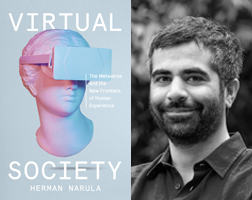
Narula, H. (2022) Virtual society: The metaverse and the new frontiers of human experience. London, UK: Penguin Business.
Let's take it outside.

The indigenous resistance to the westering anglos as they punched their way over the Appalachian Crest for the seizure and enclosing of the continent was led by a young Shawnee warrior, Tecumseh. Invited into the governor's mansion to negotiate, Tecumseh refused: "Houses are built for you to hold council in: Indians hold theirs in the open air." He also refused to take a chair when offered one, saying that he would repose on the bosom of the earth. There is a resonance here with the spirit of Occupy, and its mode of inhabiting space.

Popular protest takes to the streets because that is the space that remains. To be sure, most of the major events in history have happened outside, in the sense that the decisions taken inside—in the chancelleries, the boardrooms, the smoke-filled backrooms, etc.—are ultimately conditioned by things that happen, or do not happen, in the open air. Tecumseh's retort to Governor Harrison points up the significance of spatial and political form, and of the different architectonics of societies rooted in common—as opposed to private—property.

The spaces of modernity are shaped and dominated by private and state interests; under modernity public space is a subordinate category, residual even, and confined to what is left once land has been commodified and parceled into private lots. What remains is the open air. Literally. The air itself treated by economists as and "externality" (in the language of the business schools), which are commons of a peculiar capitalist kind. The air becomes a sink for the waste produced during the manufacture of commodities. This amounts to the theft of a common, though it is sometimes hard to see since it doesn't happen all at once, nor everywhere. Like many other things, pollution is very uneven, and has a class geography.

(...)

As more and more of modern life moves away into a representation, as the image-world comes to dominate civil society, and as the spectacular state gets drawn further into the day-to-day management of consumer obedience, internal policing, and the prevention of riposte to its lies, so the problem of image politics and of the very possibility of making spaces for strategic discussion takes on critical importance. (...) Given the de-realization of human collectivity under conditions of spectacle, these brief interruptions—the occupations of the squares and critical mass rides—produce real manifestations of community, albeit fleeting. Yet in each case it's a move beyond the horizon of representational politics, and takes life off the screen for a moment.

IB.png