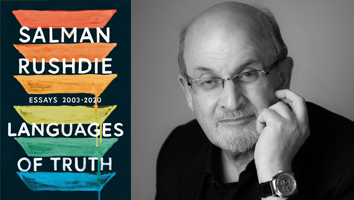
Until the age of thirteen, when I was sent from Bombay to boarding school in faraway England, I was a much more homogeneous self than I am now. I had lived in the same house in the same city all my life, in the bosom of my family, among people whose customs I knew without having to do anything as conscious as ‘know’ them, speaking the languages that people spoke in that city, in that country, in that time. These are the four roots of the self: language, place, community, custom. But in our age, the great age of migration, many of us have at least one of these roots pulled up. We move away from the place we know, away from the community that knows us, to a place where the customs are different and, perhaps, the most commonly spoken language is one we don’t know, or if we speak it, we speak it badly and cannot express in it the subjects of what we think and who we are. In my case, I had been brought up multilingually, so my English was fine, it was the one root still planted in the earth, but the others had all gone. In Norse mythology, the World Tree, the great ash Yggdrasil, has three roots. One falls into the Pool of Knowledge near Valhalla, the pool from which odin drinks, but the others are slowly being destroyed, one gnawed by a monster called the Nidhogg, the other being gradually burned away by the flames of the fire region, Muspelheim. When these two roots are destroyed, the tree falls, and the Götterdämmerung begins. The migrant too is at first a tree standing without roots, trying not to fall. Migration is an existential act, stripping us of our defences, mercilessly exposing us to a world that understands us badly, if at all: as if the earth were stripped of its atmosphere and the sun were to bear down upon it in all its pitiless force.
Death of culture, scientifically explained.
He had known all along, of course, that nothing but a theoretical engine or system ever runs at 100 percent efficiency; and about the theorem of Clausius, which states that the entropy of an isolated system always continually increases. It was not, however, until Gibbs and Boltzmann brought to this principle the methods of Statistical mechanics that the horrible significance of it all dawned on him: only then did he realize that the isolated system -galaxy, engine, human being, culture, whatever- must evolve spontaneously toward the Condition of the More Probable. He was forced, therefore, in the sad dying fall of middle age, to a radical reevaluation of everything he had learned up to then; all the cities and seasons and casual passions of his days had now to be looked at in a new and elusive light. He did not know if he was equal to the task. He was aware of the dangers of the reductive fallacy and, he hoped, strong enough not to drift into the graceful decadence of an enervated fatalism. His had always been a vigorous, Italian sort of pessimism: like Machiavelli, he allowed the forces of virtù and fortuna to be about fifty/fifty; but the equations now introduced a random factor which pushed the odds to some unutterable and indeterminate ratio which he found himself afraid to calculate.
---
Nevertheless (...) he found in entropy or the measure of disorganisation for a closed system an adequate metaphor to apply to certain phenomena in his own world. He saw, for example, the younger generation responding to Madison Avenue with the same spleen his own had once reserved for Wall Street: and in American ‘consumerism’ discovered a similar tendency from the least to the most probable, from differentiation to sameness, from ordered individuality to a kind of chaos. He found himself, in short, restating Gibbs’ prediction in social terms, and envisioned a heat death for his culture in which ideas, like heat energy, would no longer be transferred, since each point in it would ultimately have the same quantity of energy; and intellectual motion would, accordingly, cease.