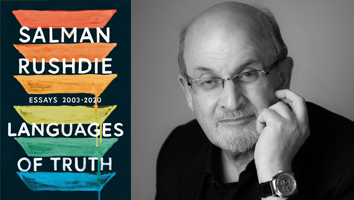
Until the age of thirteen, when I was sent from Bombay to boarding school in faraway England, I was a much more homogeneous self than I am now. I had lived in the same house in the same city all my life, in the bosom of my family, among people whose customs I knew without having to do anything as conscious as ‘know’ them, speaking the languages that people spoke in that city, in that country, in that time. These are the four roots of the self: language, place, community, custom. But in our age, the great age of migration, many of us have at least one of these roots pulled up. We move away from the place we know, away from the community that knows us, to a place where the customs are different and, perhaps, the most commonly spoken language is one we don’t know, or if we speak it, we speak it badly and cannot express in it the subjects of what we think and who we are. In my case, I had been brought up multilingually, so my English was fine, it was the one root still planted in the earth, but the others had all gone. In Norse mythology, the World Tree, the great ash Yggdrasil, has three roots. One falls into the Pool of Knowledge near Valhalla, the pool from which odin drinks, but the others are slowly being destroyed, one gnawed by a monster called the Nidhogg, the other being gradually burned away by the flames of the fire region, Muspelheim. When these two roots are destroyed, the tree falls, and the Götterdämmerung begins. The migrant too is at first a tree standing without roots, trying not to fall. Migration is an existential act, stripping us of our defences, mercilessly exposing us to a world that understands us badly, if at all: as if the earth were stripped of its atmosphere and the sun were to bear down upon it in all its pitiless force.
It's Pou. Not Poo. Not Pow. Pou. Pronounced Poe. Yup. Like Edgar Allan. That's right.
Welcome to my library
Like Pierre Menard, I get so immersed in the books I read that I can rewrite them — line by line — from memory… I wish.
All the words below are the copyright of their authors. Book titles and pictures directly link to online stores where you can buy them.