The neverending story of the blockchain miner

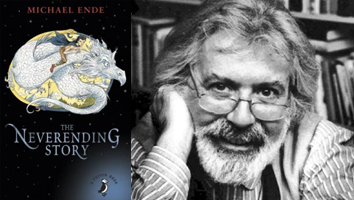
Bastian saw a large group of people, men and women, young and old, all in the strangest clothes. They didn’t speak, each one was alone with himself. On the ground lay a large number of cubes, and there were letters on all six sides of the cubes. The people kept jumbling the cubes and then staring at them.

‘What are they doing?’ Bastian whispered. ‘What sort of game is that?’

‘It’s called the jumble game,’ answered Argax. He motioned to the players and cried out: ‘Good work, children! Keep at it! Don’t give up!’

Then, turning back to Bastian he whispered in his ear: ‘They can’t talk anymore. They’ve lost the power of speech. So I thought up this game for them. As you see, it keeps them busy. It’s very simple. If you stop to think about it, you’ll have to admit that all the stories in the world consist essentially of twenty-six letters. The letters are always the same, only the arrangement varies. From letters words are formed, from word sentences, from sentences chapters, and from chapters stories. Now take a look. What do you see there?’

Bastian read:

HGIKLOPFMWEYVXQ
YXCVBNMASDFGHJKLOA
QWERTZUIOPU
ASDFGHJKLOA
MNBVXYLKJHGFDSA
UPOIUZTREWQAS
QSERTZUIOPUASDAF
ASDFGHJKLOAYXC
UPOIUZTREWQ
AOLKJHGFDSAMNBV
GKHDSRZIP
QETUOUSFHKO
YCBMWRZIP
ARCGUNIKYO
QWERTZIOPLUASD
MNBVCXYASD
LKJUONGREFGHI

‘Yes, of course,’ said Argax with a giggle, ‘it usually makes no more sense than that. But if you keep at it for a long time, words turn up now and then. Not very brilliant words, but still words. “Spinachcramp,” for instance, or “sugarbrush,” or “nosepolish.” And if you play for a hundred years, or a thousand or a hundred thousand, the law of chances tells us that a poem will probably come out. And if you play it forever, every possible poem and every possible story will have to come out, in fact every story about a story, and even this story about the two of us chatting here. It’s only logical, don’t you think?’

‘It’s horrible,’ said Bastian.

‘I wouldn’t say that,’ said Argax. ‘It depends on your point of view. It keeps these people, in a manner of speaking, busy. And anyway, what else can we do with them in Fantastica?’
The elitist nature of ink.

We live in a very visual world today. Do words have any power left?

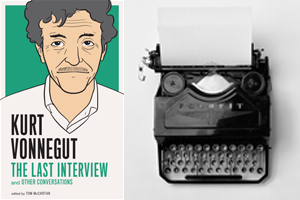
I was at a symposium some years back with my friends Joseph Heller and William Styron, both dead now, and we were talking about the death of the novel and the death of poetry, and Styron pointed out that the novel has always been an elitist art form. It’s an art form for very few people, because only a few can read very well. I’ve said that to open a novel is to arrive in a music hall and be handed a viola. You have to perform. [Laughs.] To stare at horizontal lines of phonetic symbols and Arabic numbers and to be able to put a show on in your head, it requires the reader to perform. If you can do it, you can go whaling in the South Pacific with Herman Melville, or you can watch Madame Bovary make a mess of her life in Paris. With pictures and movies, all you have to do is sit there and look at them and it happens to you.

Many years ago, you said that a writer’s job is to use the time of a stranger in such a way that he or she will not feel the time was wasted. There are a lot of ways for a stranger to pass time these days.

That’s right. There are all these other things to do with time. It used to be people would wonder what the hell they were going to do for the winter. [Laughs.] Then a big book would come out – a big, wonderful book – and everybody would be reading it to pass the time. It was a very primitive experiment, before television, where people would have to look at ink on paper, for God’s sake. I myself grew up when radio was very important. I’d come home from school and turn on the radio. There were funny comedians and wonderful music, and there were plays. I used to pass time with radio. Now, you don’t have to be literate to have a nice time.

You’ve stated that television is one of the most viable art forms in the world today.

Well, it is. It works like a dream. It’s a way to hold attention, and it’s awfully good at that. For a lot of people, TV is life itself. Churches used to provide people with better company than they had at home, but now, no matter what your neighborhood life or family life is like, you turn on the television and you get relatives, family. I don’t know if you’ve heard about this, but scientists have created baby geese that believe that an airplane is their mother. Human beings will believe in all kinds of things that aren’t true, and that’s okay. And TV is a part of that.

jr.png