La feina ben feta.

Some of us had been threatening our friend Colby for a long time, because of the way he had been behaving. And now he'd gone too far, so we decided to hang him. Colby argued that just because he had gone too far (he did not deny that he had gone too far) did not mean that he should be subjected to hanging. Going too far, he said, was something everybody did sometimes. We didn't pay much attention to this argument. We asked him what sort of music he would like played at the hanging. He said he'd think about it but it would take him a while to decide. I pointed out that we'd have to know soon, because Howard, who is a conductor, would have to hire and rehearse the musicians and he couldn't begin until he knew what the music was going to be. Colby said he'd always been fond of Ives's Fourth Symphony. Howard said that this was a "delaying tactic" and that everybody knew that the Ives was almost impossible to perform and would involve weeks of rehearsal, and that the size of the orchestra and chorus would put us way over the music budget. "Be reasonable," he said to Colby. Colby said he'd try to think of something a little less exacting.

Hugh was worried about the wording of the invitations. What if one of them fell into the hands of the authorities? Hanging Colby was doubtless against the law, and if the authorities learned in advance what the plan was they would very likely come in and try to mess everything up. I said that although hanging Colby was almost certainly against the law, we had a perfect moral right to do so because he was our friend, belonged to us in various important senses, and he had after all gone too far. We agreed that the invitations would be worded in such a way that the person invited could not know for sure what he was being invited to. We decided to refer to the event as "An Event Involving Mr. Colby Williams." A handsome script was selected from a catalogue and we picked a cream-colored paper. Magnus said he'd see to having the invitations printed, and wondered whether we should serve drinks. Colby said he thought drinks would be nice but was worried about the expense. We told him kindly that the expense didn't matter, that we were after all his dear friends and if a group of his dear friends couldn't get together and do the thing with a little bit of eclat, why, what was the world coming to? Colbv asked if he would be able to have drinks, too, before the event. We said,"Certainly."

The next item of business was the gibbet. None of us knew too much about gibbet design, but Tomas, who is an architect, said he'd look it up in old books and draw the plans. The important thing, as far as he recollected, was that the trapdoor function perfectly. He said that just roughly, counting labor and materials, it shouldn't run us more than four hundred dollars. "Good God !" Howard said. He said what was Tomas figuring on, rosewood? No, just a good grade of pine, Tomas said. Victor asked if unpainted pine wouldn't look kind of "raw," and Tomas replied that he thought it could be stained a dark walnut without too much trouble.

I said that although I thought the whole thing ought to be done really well and all, I also thought four hundred dollars for a gibbet, on top of the expense for the drinks, invitations, musicians, and everything, was a bit steep, and why didn't we just use a tree -- a nice-looking oak, or something? I pointed out that since it was going to be a June hanging the trees would be in glorious leaf and that not only would a tree add a kind of "natural" feeling but it was also strictly traditional, especially in the West. Tomas, who had been sketching gibbets on the backs of envelopes, reminded us that an outdoor hanging always had to contend with the threat of rain. Victor said he liked the idea of doing it outdoors, possibly on the bank of a river but noted that we would have to hold it some distance from the city, which presented the problem of getting the guests, musicians, etc., to the site and then back to town.

At this point everybody looked at Harry, who runs a car-and-truck-rental business. Harry said he thought he could round up enough limousines to take care of that end but that the drivers would have to be paid. The drivers, he pointed out, wouldn't be friends of Colby's and couldn't be expected to donate their services, any more than the bartender or the musicians. He said that he had about ten limousines, which he used mostly for funerals, and that he could probably obtain another dozen by calling around to friends of his in the trade. He said also that if we did it outside, in the open air, we'd better figure on a tent or awning of some kind to cover at least the principals and the orchestra, because if the hanging was being rained on he thought it would look kind of dismal. As between gibbet and tree, he said, he had no particular preferences and he really thought that the choice ought to be left up to Colby, since it was his hanging. Colby said that everybody went too far, sometimes, and weren't we being a little Draconian? Howard said rather sharply that all that had already been discussed, and which did he want, gibbet or tree? Colby asked if he could have a firing squad. No, Howard said, he could not. Howard said a firing squad would just be an ego trip for Colby, the blindfold and last-cigarette bit, and that Colby was in enough hot water already without trying to "upstage" everyone with unnecessary theatrics. Colby said he was sorry, he hadn't meant it that way, he'd take the tree. Tomas crumpled up the gibbet sketches he'd been making, in disgust.

Then the question of the hangman came up. Pete said did we really need a hangman? Because if we used a tree, the noose could be adjusted to the appropriate level and Colby could just jump off something -- a chair or stool or something. Besides, Pete said, he very much doubted if there were any free-lance hangmen wandering around the country, now that capital punishment has been done away with absolutely, temporarily, and that we'd probably have to fly one in from England or Spain or one of the South American countries, and even if we did that how could we know in advance that the man was a professional, a real hangman, and not just some money-hungry amateur who might bungle the job and shame us all, in front of every body? We all agreed then that Colby should just jump off something and that a chair was not what he should jump off of, because that would look, we felt, extremely tacky -- some old kitchen chair sitting out there under our beautiful tree. Tomas, who is quite modern in outlook and not afraid of innovation, proposed that Colby be standing on a large round rubber ball ten feet in diameter. This, he said, would afford a sufficient "drop" and would also roll out of the way if Colby suddenly changed his mind after jumping off. He reminded us that by not using a regular hangman we were placing an awful lot of the responsibility for the success of the affair on Colby himself, and that although he was sure Colby would perform creditably and not disgrace his friends at the last minute, still, men have been known to get a little irresolute at times like that, and the ten-foot-round rubber ball, which could probably be fabricated rather cheaply, would insure a "bang-up" pro duction right down to the wire.

At the mention of "wire," Hank, who had been silent all this time, suddenly spoke up and said he wondered if it wouldn't be better if we used wire instead of rope -- more efficient and in the end kinder to Colby, he suggested. Colby began looking a little green, and I didn't blame him, because there is something extremely distasteful in think ing about being hanged with wire instead of rope -- it gives you sort of a revulsion, when you think about it. I thought it was really quite unpleasant of Hank to be sitting there talking about wire, just when we had solved the problem of what Colby was going to jump off of so neatly, with Tomas's idea about the rubber ball, so I hastily said that wire was out of the question, because it would injure the tree -- cut into the branch it was tied to when Colby's full weight hit it -- and that in these days of increased respect for the environment, we didn't want that, did we? Colby gave me a grateful look, and the meeting broke up. Everything went off very smoothly on the day of the event (the music Colby finally picked was standard stuff, Elgar, and it was played very well by Howard and his boys). It didn't rain, the event was well attended, and we didn't run out of Scotch, or anything. The ten-foot rubber ball had been painted a deep green and blended in well with the bucolic setting. The two things I remember best about the whole episode are the grateful look Colby gave me when I said what I said about the wire, and the fact that nobody has ever gone too far again.
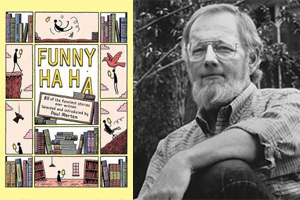
Donald Barthelme (1973) Some of us had been threatening our friend Colby in Paul Merton (2019) Funny Ha, Ha

(Not always fake, but often sloppy) Media

I’m tired of television announcers, hosts, newscaster, and commentators, nibbling away at the English language, making obvious and ignorant mistakes. If I were in charge of America’s broadcast stations and networks, I would gather together all the people whose jobs include speaking to the public, and I would not let them out of the room until they had absorbed the following suggestions. And I’m aware that media personalities are not selected on the basis of intelligence. I know that, and I try to make allowances for it. Believe me, I really try. But still… There are some liberties taken with speech that I think require intervention, if only for my own sake. I won’t feel right if this chance goes by, and I keep my silence.

The English word forte, meaning "specialty" or "strong point," is not pronounced "for-tay." Got that? It is pronounced "fort." The Italian word forte, used in music notation, is pronounced "for-tay," and it instructs the musician to play loud: "She plays the skin flute, and her forte [fort] is playing forte [for-tay]." Look it up. And don’t give me that whiny shit, "For-tay is listed as the second preference." There’s a reason it’s second: because it’s not first!
Irony deals with opposites; it has nothing to do with coincidence. If two baseball players from the same hometown, on different teams, receive the same uniform number, it is not ironic. It is a coincidence. If Barry Bonds attains lifetime statistics identical to his father’s it will not be ironic. It will be a coincidence. Irony is "a state of affairs that is the reverse of what was to be expected; a result opposite to and in mockery of the appropriate result." For instance:
If a diabetic, on his way to buy insulin, is killed by a runaway truck, he is the victim of an accident. If the truck was delivering sugar, he is the victim of an oddly poetic coincidence. But if the truck was delivering insulin, ah! Then he is the victim of an irony.
If a Kurd, after surviving bloody battle with Saddam Hussein’s army and a long, difficult escape through the mountains, is crushed and killed by a parachute drop of humanitarian aid, that, my friend, is irony writ large.
Darryl Stingley, the pro football player, was paralyzed after a brutal hit by Jack Tatum. Now Darryl Stingley’s son plays football, and if the son should become paralyzed while playing, it will not be ironic. It will be coincidental. If Darryl Stingley’s son paralyzes someone else, that will be closer to ironic. If he paralyzes Jack Tatum’s son that will be precisely ironic.

I’m tired of hearing prodigal being used to mean "wandering, given to running away or leaving and returning." The parable in the Book of Luke tells of a son who squanders his father’s money. Prodigal means "recklessly wasteful or extravagant." And if you say popular usage has changed that, I say, fuck popular usage!

The phrase sour grapes does not refer to jealousy or envy. Nor is it related to being a sore loser. It deals with the rationalization of failure to attain a desired end. In the original fable by Aesop, "The Fox and the Grapes," when the fox realizes he cannot leap high enough to reach the grapes, he rationalizes that even if he had gotten them, they would probably have been sour anyway. Rationalization, that’s all sour grapes means. It doesn’t mean deal with jealousy or sore losing. Yeah, I know you say, "Well many people are using it that way, so the meaning is changing." And I say, "Well many people are really fuckin’ stupid too, shall we just adopt all their standards?"

Strictly speaking, celibate does not mean not having sex, it means not being married. No wedding. The practice of refraining from sex is called chastity or sexual abstinence. No fucking. Priests don’t take a vow of celibacy, they take a vow of chastity. Sometimes referred to as the "no-nookie clause."

And speaking of sex, the Immaculate Conception does not mean Jesus was conceived in the absence of sex. It means Mary was conceived without Original Sin. That’s all it has ever meant. And according to the tabloids, Mary is apparently the only one who can make such a claim. The Jesus thing is called virgin birth.

Proverbial is now being used to describe things that don’t appear in proverbs. For instance, "the proverbial drop in the bucket" is incorrect because "a drop in the bucket" is not a proverb, it’s a metaphor. You wouldn’t say, "as welcome as a turd in the proverbial punchbowl," or "as cold as the proverbial nun’s box," because neither refers to a proverb. The former is a metaphor, the latter is a simile.

Momentarily means for a moment, not in a moment. The word for "in a moment" is presently "I will be there presently, Dad, and then, after pausing momentarily, I will kick you in the nuts."

No other option and no other alternative are redundant. The words option and alternative already imply otherness. "I had no option, Mom, I got this huge erection because there was no alternative." This rule is not optional; the alternative is to be wrong.

You should not use criteria when you mean criterion for the same reason that you should not use criterion when you mean criteria. These is my only criterions.

A light-year is a measurement of distance, not time. "It will take light-years for young basketball players to catch up with the number of women Wilt Chamberlain has fucked, "is a scientific impossibility. Probably in more ways than one.

An acronym is not just any set of initials. It applies only to those that are pronounced as words. MADD, DARE, NATO, and UNICEF are acronyms. FBI, CIA, and KGB are not. They’re just pricks.

I know I’m fighting a losing battle with this one, but I refuse to surrender: Collapsing a building with explosives is not an implosion. An implosion is a very specific scientific phenomenon. The collapsing of a building with explosives is the collapsing of a building with explosives. The explosives explode, and the building collapses inwardly. That is not an implosion. It is an inward collapsing of a building, following a series of smaller explosions designed to make it collapse inwardly. Period. Fuck you!

Here’s another pointless, thankless objection I’d like to register. I say it that way, because I know you people and your goddamn "popular usage" slammed the door on this one a long time ago. But here goes anyway:

A cop out is not an excuse, not even a weak one; it is an admission of guilt. When someone "cops a plea," he admits guilt to some charge, in exchange for better treatment. He has "copped out." When a guy says, "I didn’t get to fuck her because I reminded her of her little brother," he is making an excuse. If he says, "I didn’t get to fuck her because I’m an unattractive schmuck," he is copping out. The trouble arises when an excuse contains a small amount of self-incriminating truth.

This one is directed to the sports people: You are destroying a perfectly good figure of speech: "Getting the monkey off one’s back" does not mean breaking a losing streak. It refers only to ending a dependency. That’s all. The monkey represents a strong yen. A loosing streak does not compare even remotely. Not in a literary sense and not in real life.

Here’s one you hear from the truly dense: "The proof is in the pudding." Well, the proof is not in the pudding; the rice and raisins are in the pudding. The proof of the pudding is in the eating. In this case, proof means "test." The same is true of "the exception that proves (tests) the rule."

An eye for an eye is not a call for revenge, it is an argument for fairness. In the time of the Bible, it was standard to take a life in exchange for an eye. But the Bible said, No, the punishment should fit the crime. Only and eye for an ey, nothing more. It is not vindictive, it is mitigatory.

Don’t make the same mistake twice seems to indicate three mistakes, doesn’t it? First you make the mistake. Then you make the same mistake. Then you make the same mistake twice. If you simply say, "Don’t make the same mistake, " you’ll avoid the first mistake.

Unique needs no modifier. Very unique, quite unique, more unique, real unique, fairly unique, and extremely unique are wrong and they mark you as dumb, although certainly not unique.

Healthy does not mean "healthful." Healthy is a condition, healthful is a property. Vegetable aren’t healthy, they’re dead. No food is healthy. Unless you have an eggplant that’s doing push-ups. Push-ups are healthful.

There is no such thing or word as kudo. Kudos is a singular noun meaning praise, and it is pronounced kyoo-dose. There is also a plural form, spelled the same, but pronounced kyoo-doze. Please stop telling me, "So-and-so picked up another kudo today."

Race, creed, or color is wrong. Race and color, as used in this phrase, describe the same property. And "creed" is a stilted, outmoded way of saying "religion." Leave this tired phrase alone; it has lost its usefulness. Besides, it reeks of insincerity no matter who uses it.

As of yet is simply stupid. As yet, I’ve seen no progress on this one, but of course I’m speaking as of now.

Here’s one you can win money on in a bar if you’re within reach of the right reference book: Chomping at the bit and old stomping ground are incorrect. Some Saturday afternoon when you’re getting bombed on your old stamping ground, you’ll be champing at the bit to use this one.

Sorry to sound so picky, folks, but I listen to a lot of radio and TV and these things have bothered me for a long time.

George Carlin (1997) If I Were in Charge of the Networks
In Andy Borowitz (2011) The 50 Funniest American Writers